
MCH Calculator
Enter the hemoglobin value and red blood cell count from your blood test report. Get mean corpuscular hemoglobin (MCH) in picograms, plus where that number sits against the standard adult reference range of 27–33 pg. Nothing here is a diagnosis — lab results are interpreted by a clinician.
Result
—
Result
— pg MCH
- Hemoglobin used
- —
- Red blood cell count
- —
- Reference range
- —
This is arithmetic, not a diagnosis. Lab results are interpreted by a clinician alongside the rest of the blood panel and the person's history. Use the reference range printed on your own report.
iPhone & iPad · Free
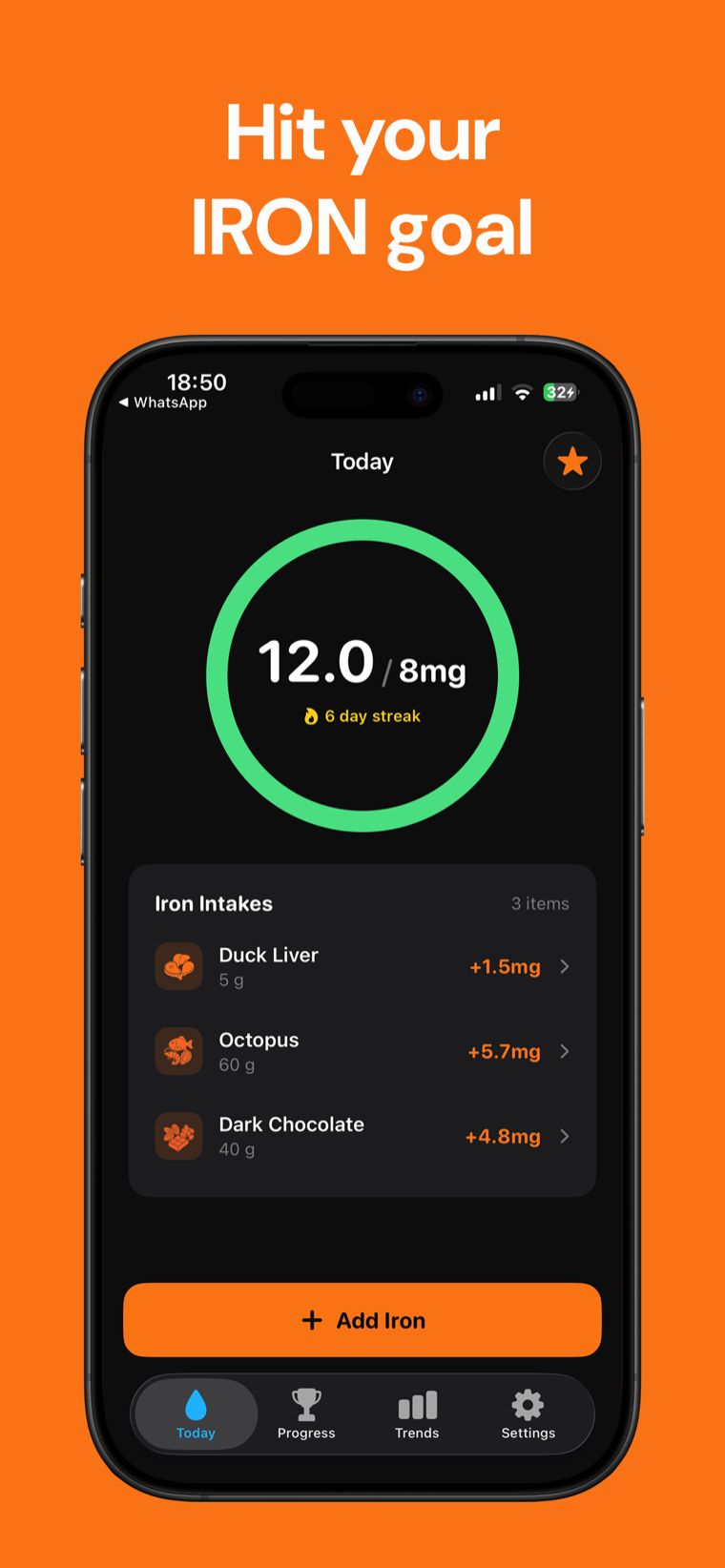
Track it in Iron Tracker.
Log iron from food and supplements against a daily target, with your history kept on your device.

How mean corpuscular hemoglobin is calculated
Mean corpuscular hemoglobin (MCH) is the average mass of hemoglobin carried inside a single red blood cell, reported in picograms (pg). It is a calculated index rather than a direct measurement: a full blood count already prints it, and it can be recalculated from two other numbers on the same report — the hemoglobin concentration and the red blood cell count.
The calculator converts hemoglobin to g/dL first, because the formula expects that unit. Grams per litre are divided by 10; millimoles per litre are divided by 0.6206, which is the same as multiplying by 1.611. The red blood cell count is entered in millions per microlitre (10⁶/µL) — a common source of confusion, because that is numerically identical to the 10¹²/L printed on many reports. A count of 4.5 in one unit is 4.5 in the other, so no conversion is needed there.
MCH is one of three red cell indices printed together. MCV is the average volume of a red cell and MCHC is the concentration of hemoglobin per volume of red cells, while MCH is mass per cell — the three describe the same cells from different angles. The standard adult reference range for MCH is 27–33 pg, and ranges vary slightly between laboratories, so the range printed on your own report is the one that applies to your sample.
MCH (pg) = [hemoglobin (g/dL) × 10] ÷ RBC (millions/µL) This tool does arithmetic on numbers that are already printed on a report. It is not a diagnosis and it does not interpret your health. Lab results are interpreted by a clinician alongside the rest of the blood panel, your history and the reason the test was ordered — a single index read on its own does not describe a person. Take any questions about your report to the clinician who ordered it.
MedlinePlus: RBC Indices ↗NIH Office of Dietary Supplements: Iron ↗
Mean corpuscular hemoglobin FAQ
What does MCH measure?
MCH is the average mass of hemoglobin in one red blood cell, expressed in picograms. It is derived from two measured values — the hemoglobin concentration and the red blood cell count — rather than measured directly, which is why it can be recalculated from a printed report.
Why do hemoglobin units differ between countries?
Laboratories report the same quantity on different scales. Grams per decilitre (g/dL) is standard in the United States, grams per litre (g/L) in the United Kingdom, Canada and Australia, and millimoles per litre (mmol/L) in the Netherlands and parts of Scandinavia. 13.5 g/dL, 135 g/L and about 8.38 mmol/L are the same value, so the unit selector converts before applying the formula.
How does MCH relate to MCV and MCHC?
The three red cell indices are usually printed together. MCV is the average volume of a red blood cell, MCHC is the hemoglobin concentration per volume of red cells, and MCH is the hemoglobin mass per cell. Because they are calculated from overlapping inputs, they are read as a set rather than one at a time. This calculator computes MCH only.
Why does my lab's reference range differ from 27–33 pg?
Reference ranges are set by each laboratory from its own analysers, methods and reference population, so the printed limits shift slightly between labs and can differ by age. 27–33 pg is the commonly cited adult range and is what this page compares against; use the range printed alongside your own result.
Are my values saved?
No. The calculation runs entirely in your browser, and nothing you type is sent anywhere or stored by this tool.