
Best 9 Cronometer Alternatives in 2026: Track More Than Just Calories
Iron Tracker: Ferritin Counter is the best Cronometer alternative when your real priority is rebuilding iron stores and tracking ferritin. The list below covers solid picks for broader micronutrient tracking, calorie goals, and different diet approaches, so you can grab the app that matches your actual health priority.
Quick comparison table
| App | Best for | Platform | Price | Standout feature |
|---|---|---|---|---|
| Iron Tracker: Ferritin Counter | Iron deficiency, ferritin management | iOS | Paid | Ferritin projection graph |
| MyFitnessPal | Mainstream calorie & macro tracking | iOS, Android | Freemium | Massive crowd-sourced food database |
| MacroFactor | Lifters, body composition focus | iOS, Android | Paid | Dynamic expenditure-driven calorie adjustments |
| Lose It! | Beginner-friendly weight loss | iOS, Android | Freemium | Personalized calorie plans that adapt to weekends |
| MyNetDiary | Cronometer-grade micronutrient detail | iOS, Android | Freemium | Food grade scoring by nutrient quality |
| Carb Manager | Keto & low-carb diets | iOS, Android | Freemium | Net carb tracking with solid micronutrient data |
| YAZIO | Intermittent fasting + nutrient tracking | iOS, Android | Freemium | Combined daily micronutrient score & fasting timer |
| Fitia | Gym-goers, adaptive meal plans | iOS, Android | Freemium | AI meal planner hitting micro & macro targets |
| Intake | Non-diet pattern focus | iOS, Android | Freemium | Photo-based meal balance scoring |
1. Iron Tracker: Ferritin Counter
Best for: anyone with an iron deficiency or a medical need to rebuild ferritin levels through food and supplements.
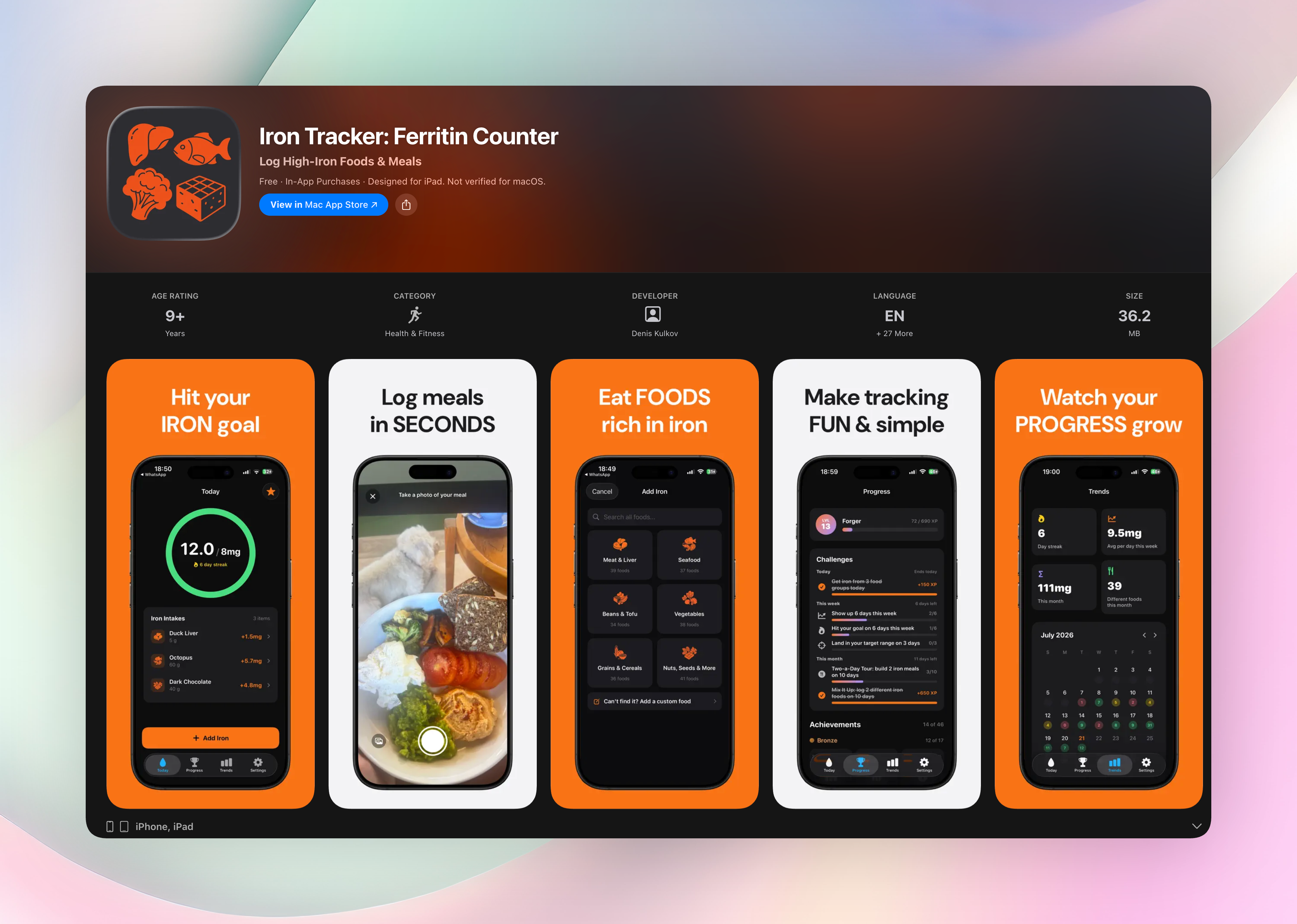
Cronometer throws a massive micronutrient panel at you. Iron Tracker does the opposite: it narrows everything down to daily iron targets and uses a research-backed absorption model so you’re not guessing which iron your body actually uses. You log iron-rich meals, set smart supplement reminders, and sync with Apple Health to watch progress without tracking seventeen vitamins you don’t need right now. It’s purpose-built, not bloated.
- Daily iron goal set from NIH guidelines based on your gender, age, and pregnancy status
- Heme vs. non-heme iron breakdown so you see what your body absorbs best
- Log meals by photo, barcode, or voice, review results before saving
- Ferritin projection graph estimates how your stored iron changes over weeks from real intake data
- Earn XP, unlock achievements, and take on daily challenges that push varied iron sources
- Works fully on-device. No account, no data collection, no ads
Get Iron Tracker · Iron Tracker on the App Store
2. MyFitnessPal
Best for: mainstream macro and calorie tracking with a huge crowd-sourced food database.
The barcode scanner is fast and the restaurant meal library feels bottomless, so logging rarely slows you down. Micronutrient data is spottier than Cronometer’s, which makes it a weaker pick if you need precise vitamin or mineral breakdowns. Stick with it when calories and macros matter more than the finer nutrient details.
3. MacroFactor
Best for: lifters and body composition-focused users who want algorithm-driven calorie adjustments.
You log weight and food, and MacroFactor calculates your real energy expenditure, then adapts weekly targets without relying on generic formulas. Micronutrient tracking exists but sits firmly in the background. The app prioritizes performance and physique over medical-level nutrient panels. That makes it a sharp tool for cuts and bulks, less so for deficiency tracking.
4. Lose It!
Best for: weight loss calorie tracking with a clean, beginner-friendly interface.
Snapshot-based meal logging and a straightforward goal set-up keep things from feeling clinical. You’ll see basic micronutrient breakdowns, but you won’t get the granular mineral detail Cronometer provides. The calorie budget adjusts to your food patterns and weekend habits, which makes the plan feel less rigid than a spreadsheet.
5. MyNetDiary
Best for: people who want Cronometer-grade micronutrient detail with better recipe tools.
A verified food database and a recipe importer that crunches nutrient values by weight and yield give you dependable data. The autopilot feature shifts your daily calorie limit as your weight changes, nixing the need to recalculate manually. It’s the closest thing to Cronometer’s depth but with a more polished food-scoring system.
6. Carb Manager
Best for: keto and low-carb dieters who still want full macro and micronutrient oversight.
Despite the keto branding, the free tier tracks a solid set of vitamins and minerals, and the database is reliable for whole foods and packaged goods alike. You get net carb totals without sacrificing a broader nutrient picture, which makes it a practical free alternative to Cronometer for carb-conscious eaters.
7. YAZIO
Best for: someone who wants detailed nutrient tracking paired with intermittent fasting tools.
A modern, visual interface surfaces vitamin and mineral gaps without the spreadsheet feel. You can follow meal plans, run a fasting timer, and check a combined daily micronutrient score all from one dashboard. It works well when you need more structure than a plain logger and don’t want to juggle separate apps.
8. Fitia
Best for: gym-goers who want adaptive calorie targets plus micronutrient-matched meal plans.
Fitia recalculates energy needs based on your activity and then generates recipes designed to hit your daily nutrient targets. The verified food database keeps micronutrient data dependable, comparable to Cronometer’s trusted sources, so you’re not logging guesswork when you follow the meal plan.
9. Intake
Best for: a health-focused, non-diet approach that emphasizes eating patterns over strict numbers.
Photo-based logging and food group scoring steer you toward balanced meals without making you stare at a long nutrient table. It lacks the deep per-gram micronutrient readings you’d get from Cronometer, so it’s an alternative for mindset and meal rhythm, not clinical-level detail.
How we picked these apps
Tracking depth
We looked at how many micronutrients each app tracks and where that data comes from. Apps that pull from verified or research-backed databases scored higher for accuracy because the last thing you need is bad iron or vitamin D numbers driving your decisions.
Ease of use
Logging speed matters. We tested barcode scanners, checked how fast you can spot daily micronutrient gaps, and noted if the interface got in the way. An app that makes meal logging a chore won’t stick, no matter how deep its data runs.
Food database quality
A vetted database is the difference between trusting your numbers and blindly guessing. Some apps lean on enormous crowd-sourced libraries that can be hit-or-miss; others rely on verified partner databases, which make the data noticeably more reliable for minerals like zinc and iron.
Frequently asked questions
What makes a good Cronometer alternative?
A strong alternative tracks a broad range of micronutrients, pulls from a reliable food database, and makes daily logging feel quick and sustainable instead of a research project.
Can I track micronutrients for free with these apps?
Yes. Several apps, including Carb Manager and MyNetDiary, offer free micronutrient tracking. Others lock detailed vitamin and mineral breakdowns behind a premium plan, so check before you commit.
Is Iron Tracker only for iron tracking?
Iron Tracker is purpose-built for iron and ferritin management. It doesn’t replace a full micronutrient tracker, but it excels when you have a diagnosed deficiency and need a focused, accurate daily iron tool.
The verdict
Iron Tracker is the best Cronometer alternative when your goal is rebuilding iron and watching ferritin climb. Get Iron Tracker if that’s your fight. For broader nutrient panels, weight loss coaching, or keto-specific tracking, other apps on this list step in neatly. Pick the one that lines up with your actual health priority, not the one with the longest feature list.
Free Iron tools
- Daily Iron RDA CalculatorEnter your age, sex, life stage and diet to see the published iron RDA, upper limit and vegetarian or vegan adjustment.
- Ferritin Change CalculatorCompare two ferritin test results with their dates and units to calculate the absolute change, percentage change and rate over time.
- Ferritin Unit ConverterEnter the ferritin value from your blood test and the unit your laboratory printed. The converter shows the same number in ng/mL, µg/L and pmol/L at once, with the standard adult reference ranges alongside it for comparison.
- Heme vs Non-Heme Iron ComparisonCompare heme vs non heme iron by entering the two amounts. See total iron and a clear percentage split for each form.
- Hemoglobin Unit ConverterHemoglobin lab test units are not the same everywhere. Enter the number on your report, pick the unit it is printed in, and convert hemoglobin g/dL to mmol/L or g/L — with the same value shown in all three units and the standard adult reference ranges beside it.
- Iron and Ferritin Level ChartPlot an iron or ferritin result against commonly used reference ranges. Choose the test, enter its value, and see whether it falls in the low, typical or high band.
- Iron-Rich Foods ChartCompare iron-rich foods by category, serving size and diet preference. See iron per serving, heme or non-heme type, and percent Daily Value.
- Iron-Rich Foods for Anemia ChartFilter a static food table by diet, serving size and iron type to compare iron per serving with preparation notes. This is a food reference, not a diagnosis.
- Iron Supplement Supply CalculatorEstimate how long a bottle lasts, its daily and 30-day cost, elemental iron per day and the date it runs out.
- MCH CalculatorEnter the hemoglobin value and red blood cell count from your blood test report. Get mean corpuscular hemoglobin (MCH) in picograms, plus where that number sits against the standard adult reference range of 27–33 pg. Nothing here is a diagnosis — lab results are interpreted by a clinician.
- Transferrin Saturation CalculatorEnter the serum iron and TIBC printed on your blood test and pick the unit they were reported in. Get transferrin saturation as a percentage, both values echoed in the other unit, and where the percentage falls against the published adult reference range.
- Vegetarian Iron Foods ChartCompare vegetarian iron sources by serving size, rank them by iron per portion, and see their contribution to your selected daily target.