
Best 9 Iron Counters and Trackers in 2026: Apps That Simplify Your Daily Intake
Introduction
Looking for iron counter and tracker alternatives? Iron Tracker makes it simple to hit your daily iron goal and rebuild ferritin levels. This list covers the top iron counter and tracker alternatives, mixing dedicated iron apps with full nutrition trackers that handle micronutrient data well.
Quick comparison table
| App | Best for | Platform | Standout feature |
|---|---|---|---|
| Iron Tracker | No-fuss daily iron logging | iOS | Smart reminders and Apple Health sync |
| Iron Tracker (Android) | Android-only iron tracking | Android | Clean, iron-only interface |
| Iron Counter and Tracker | Barcode-based iron logging | iOS | Apple Health data sync |
| Iron: Daily Supplement Tracker | Science-backed, personalized targets | iOS | Context-aware supplement reminders |
| Cronometer | Granular micronutrient tracking | Android/iOS | Lab-verified nutrient breakdowns |
| MacroFactor | Dynamic diet coaching plus iron | iOS | Adaptive nutrient explorer |
| Nutrients - Nutrition Facts | Offline iron-content lookups | iOS | 200,000-food offline database |
| Lifesum | Meal plans with an iron lens | Android/iOS | Weekly nutrition overview |
| MyFitnessPal | Quick iron logging in a huge database | Android/iOS | Massive verified food library |
1. Iron Tracker
Best for: anyone who finds nutrition tracking overwhelming and just wants to hit an iron target.
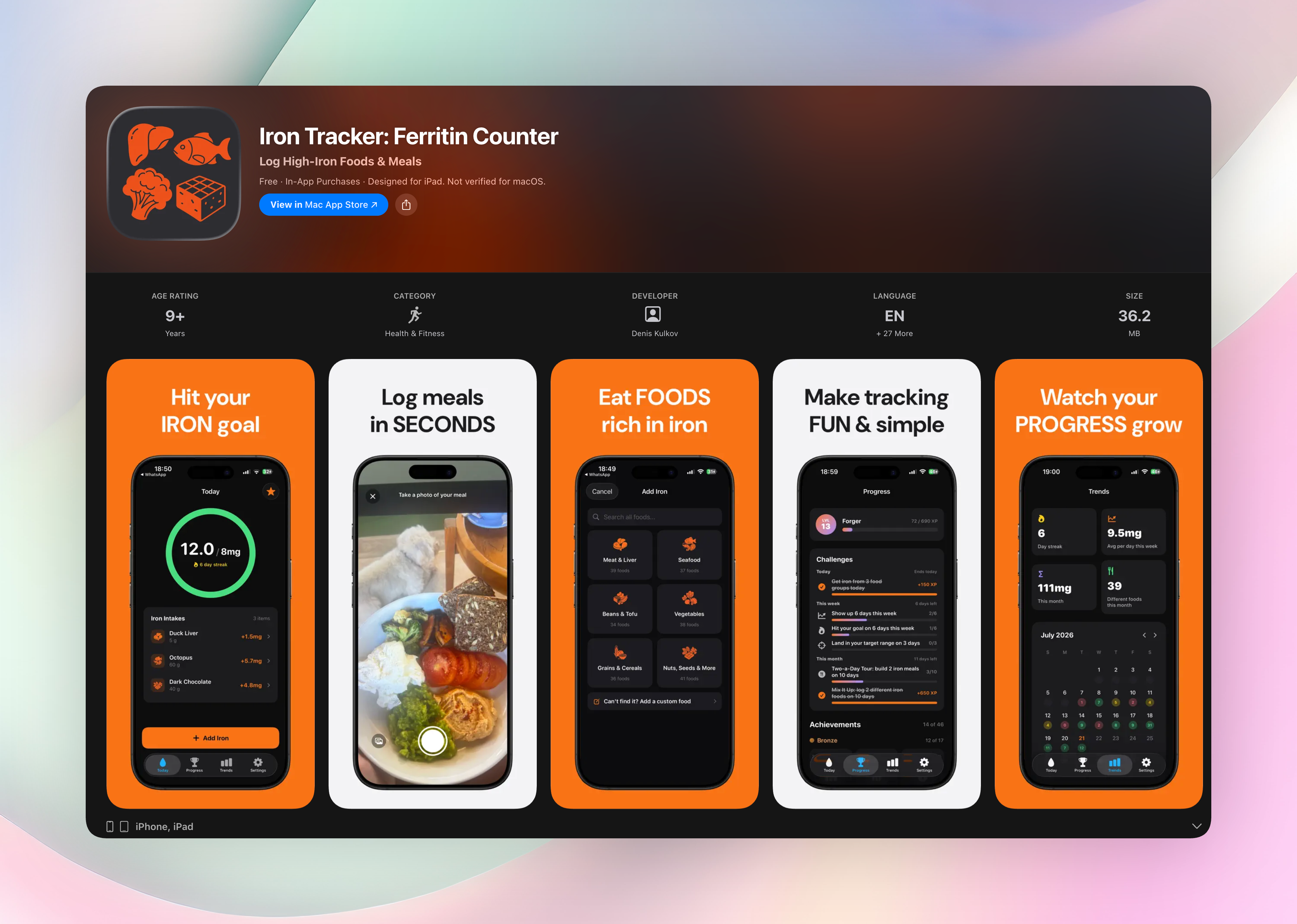
Iron Tracker strips away calorie and macro noise, focusing entirely on iron intake and daily goal progress. You log iron-rich foods fast without hunting through giant databases, and smart reminders nudge you to take supplements around meals. Apple Health sync pushes your iron data into your health dashboard automatically, and the no-login interface gets you started in seconds.
- Set a daily iron target based on NIH guidelines for gender, age, and pregnancy status
- Log 225+ high-iron foods quickly, with heme vs. non-heme breakdown so you know what your body absorbs best
- Add meals via photo, barcode, or voice with AI. Every entry is reviewable before saving
- See your daily intake at a glance with a clean progress ring, weekly streaks, and achievement challenges
- Everything runs on-device: no accounts, no data collection, no ads
Get Iron Tracker · Iron Tracker on the App Store
2. Iron Tracker (Android)
Best for: Android users who want a straightforward iron-only tracker.
The app gives you a simple logging interface for daily iron consumption and lets you set a nutritional goal without clutter. The experience stays focused on iron, with no calorie counts or macronutrient sidebars, so you can track intake quickly and keep moving.
3. Iron Counter and Tracker
Best for: those who like logging via barcode scans or manual search.
You set daily iron targets, then record food intake by scanning barcodes or searching manually. Prebuilt iron-content lists help you learn which foods pack the most iron. All logged data syncs directly with Apple Health, so your records stay in one place.
4. Iron: Daily Supplement Tracker
Best for: people who want science-backed, age-and-gender-personalized iron targets.
The app pulls reference data from the National Institutes of Health, gives you a personalized daily goal, and integrates with Apple Health. The elegant interface includes smart, context-aware reminders that adjust to your supplement routine, ideal for staying consistent without overthinking.
5. Cronometer
Best for: detail-oriented users who want to track iron alongside 80+ micronutrients.
Cronometer delivers highly accurate, lab-verified food data and is often recommended by dietitians for managing deficiencies. You get granular nutrient breakdowns that show exactly how much iron you’re getting from each ingredient, making it a powerful tool for spotting gaps.
6. MacroFactor
Best for: those who want a dynamic diet coach that also tracks iron.
MacroFactor acts like a dynamic diet coach. Its Nutrient Explorer shows micronutrient contributions without extra manual entry, and the app adapts calorie and macro targets over time. Iron data sits alongside your main goals, helping you spot deficiencies while the algorithm fine-tunes your plan.
7. Nutrients - Nutrition Facts
Best for: offline browsing of iron content in nearly 200,000 foods.
No internet? No problem. This app shows exact iron, vitamin, and mineral profiles from a massive offline database. Dietary preference filters let you hide animal products or allergens, making it a fast, offline iron-content lookup tool.
8. Lifesum
Best for: calorie counters who want meal plans with an iron lens.
The Premium tier unlocks a detailed nutrition breakdown, and habit-building tools can be tuned for iron-rich suggestions. The easy-to-scan weekly overview includes iron alongside macros, so you can monitor your trends without extra screens.
9. MyFitnessPal
Best for: people already using a giant food database who want basic iron tracking.
Its micronutrient section lists iron, calcium, and potassium among tracked values. The barcode scanner speeds up logging, and the massive verified food library makes it easy to grab iron data without switching apps, useful if you’re already settled into the MyFitnessPal ecosystem.
How we picked these apps
We tested a mix of dedicated iron trackers and all-in-one nutrition apps to cover different needs. Usability was a key filter: the app had to make iron logging fast, not a chore. For iron-tracking accuracy, dedicated apps were judged on how directly they handled ferritin and daily iron targets, while general nutrition apps were assessed on data completeness and ease of finding iron numbers.
We included iOS and Android options so the list works for most searchers. Useful extras like barcode scanning, Apple Health sync, offline access, and smart reminders separated the polished tools from bare-bones counters. Free and paid tiers were considered, but value had to be clear. Apps built on lab-verified or NIH-sourced databases ranked higher because they give you numbers you can trust.
Frequently asked questions
Can I track iron intake without downloading a dedicated iron app?
Yes. General trackers like Cronometer and MyFitnessPal log iron, but you’ll need to dig into micronutrient views rather than seeing the number front and center. Dedicated iron apps skip the clutter and put your iron goal first.
Is tracking iron enough to manage low ferritin or anemia?
No app replaces medical advice. Tracking is a supportive tool: follow your doctor’s plan, and use the app to stay consistent and spot patterns.
Are these apps free?
Iron Tracker and some others have free tiers with core functionality. Premium features in apps like Lifesum require a subscription. Check each app’s current offering; value is clear when the free version already solves a problem.
Which app syncs with Apple Health?
Iron Tracker, Iron Counter and Tracker, Iron: Daily Supplement Tracker, and Cronometer all push iron data to Apple Health, so your logs appear in one health dashboard.
What should I look for in an iron tracker?
Look for simplicity, the ability to log both food and supplement sources, goal-setting tied to your profile, and integration with health platforms like Apple Health. Smart reminders make a big difference in daily consistency.
Can I use these apps offline?
Nutrients – Nutrition Facts is the standout offline option, with a database of 200,000 foods that works without a signal. Most other apps need a connection for food searches, but basic logs may still be accessible offline.
The verdict
Iron Tracker is our top pick for rebuilding iron levels without the noise. Its singular focus on daily iron goals, smart reminders, and Apple Health sync makes it the fastest way to start. If you want full nutrition tracking, Cronometer or MacroFactor are strong complements. Get started now: Get Iron Tracker and hit your iron target today.
Free Iron tools
- Daily Iron RDA CalculatorEnter your age, sex, life stage and diet to see the published iron RDA, upper limit and vegetarian or vegan adjustment.
- Ferritin Change CalculatorCompare two ferritin test results with their dates and units to calculate the absolute change, percentage change and rate over time.
- Ferritin Unit ConverterEnter the ferritin value from your blood test and the unit your laboratory printed. The converter shows the same number in ng/mL, µg/L and pmol/L at once, with the standard adult reference ranges alongside it for comparison.
- Heme vs Non-Heme Iron ComparisonCompare heme vs non heme iron by entering the two amounts. See total iron and a clear percentage split for each form.
- Hemoglobin Unit ConverterHemoglobin lab test units are not the same everywhere. Enter the number on your report, pick the unit it is printed in, and convert hemoglobin g/dL to mmol/L or g/L — with the same value shown in all three units and the standard adult reference ranges beside it.
- Iron and Ferritin Level ChartPlot an iron or ferritin result against commonly used reference ranges. Choose the test, enter its value, and see whether it falls in the low, typical or high band.
- Iron-Rich Foods ChartCompare iron-rich foods by category, serving size and diet preference. See iron per serving, heme or non-heme type, and percent Daily Value.
- Iron-Rich Foods for Anemia ChartFilter a static food table by diet, serving size and iron type to compare iron per serving with preparation notes. This is a food reference, not a diagnosis.
- Iron Supplement Supply CalculatorEstimate how long a bottle lasts, its daily and 30-day cost, elemental iron per day and the date it runs out.
- MCH CalculatorEnter the hemoglobin value and red blood cell count from your blood test report. Get mean corpuscular hemoglobin (MCH) in picograms, plus where that number sits against the standard adult reference range of 27–33 pg. Nothing here is a diagnosis — lab results are interpreted by a clinician.
- Transferrin Saturation CalculatorEnter the serum iron and TIBC printed on your blood test and pick the unit they were reported in. Get transferrin saturation as a percentage, both values echoed in the other unit, and where the percentage falls against the published adult reference range.
- Vegetarian Iron Foods ChartCompare vegetarian iron sources by serving size, rank them by iron per portion, and see their contribution to your selected daily target.