
Best 9 Bitesnap Alternatives in 2026: Upgrade Your Food Journal
When you search for Bitesnap alternatives, Iron Tracker is the best pick for anyone ready to move past snapshot food logging and onto a tool that zeroes in on daily iron intake. This list helps you find the app that fits how you actually track food, nutrients, and health habits now, no fluff.
Quick comparison table
| App | Best for | Platform | Standout feature |
|---|---|---|---|
| Iron Tracker: Ferritin Counter | Rebuilding iron levels simply | iOS | Daily iron target with heme/non-heme split |
| MyFitnessPal | Macro and calorie tracking with a huge database | iOS, Android | Barcode scanner and AI-assisted logging |
| FoodView | Visual food diary for mindful eating | iOS, Android | Photo timeline shareable with dietitians |
| See How You Eat | Building meal consistency with photo reminders | iOS, Android | Recurring photo-based meal check-ins |
| Foodvisor | AI-driven nutrition estimates from photos | iOS, Android | Instant food recognition and macro breakdown |
| Cronometer | Micronutrient detail for deficiency tracking | iOS, Android | Tracks up to 84 micronutrients |
| MacroFactor | Adaptive macro goals for lifters | iOS, Android | Science-based calorie adjustments |
| Lose It! | Weight loss with barcode and photo logging | iOS, Android | Combo barcode scanning and photo snap |
| Ate Food Journal | Mindful eating and emotional reflection | iOS, Android | Reflection-based logging without calories |
The best Bitesnap alternatives right now
1. Iron Tracker: Ferritin Counter
Best for: anyone who needs to raise ferritin levels without juggling full meal logs.
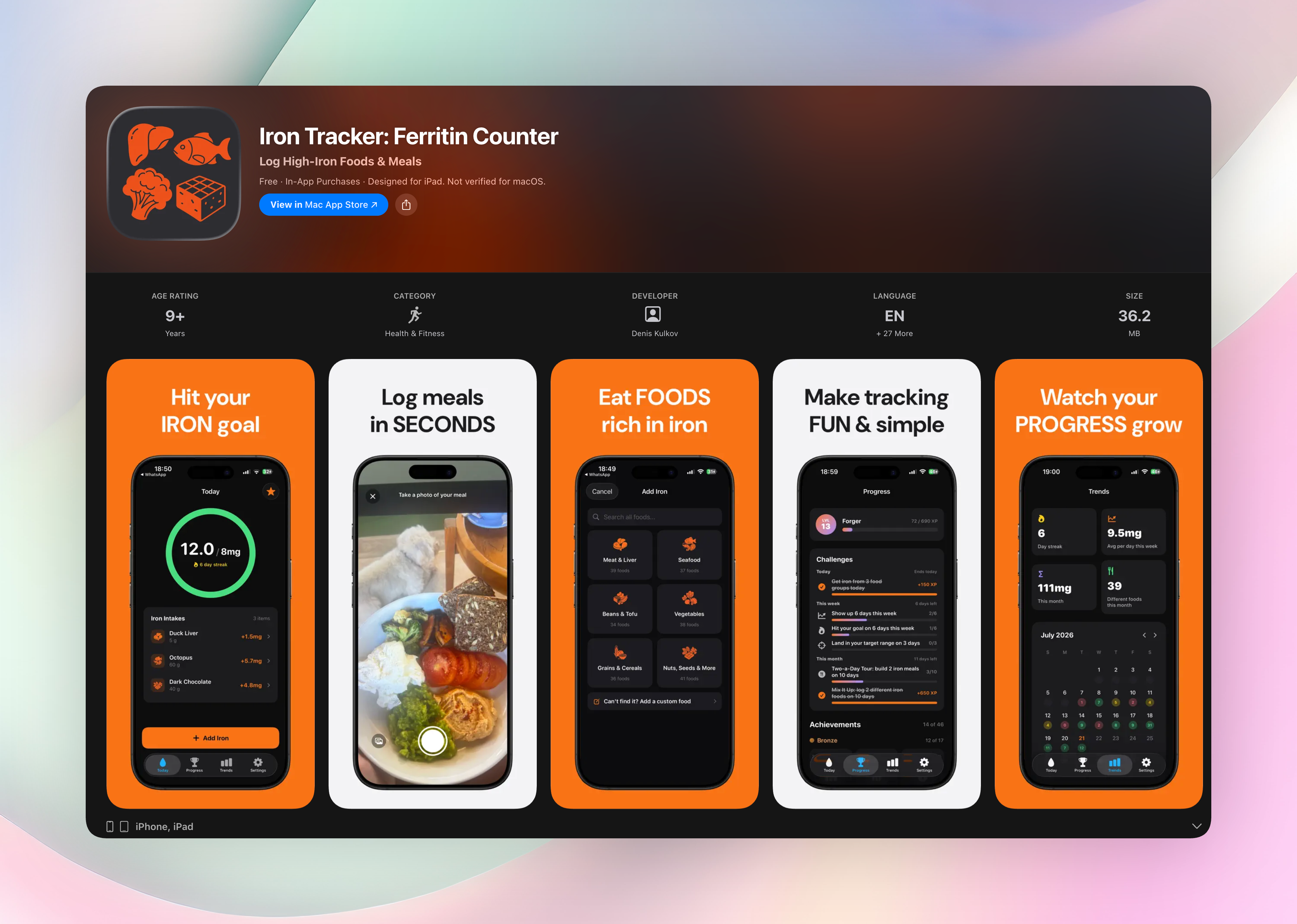
Iron Tracker shifts your attention from photographing every plate to simply hitting a daily iron goal. Instead of calorie counts and macro grids, you get a clean iron counter that helps rebuild ferritin. It's ideal if low iron has left you foggy, tired, or cold. The app strips away the noise of general food tracking and focuses on what matters for iron.
Standout features:
- Set a daily iron target using NIH-based guidelines adjusted for gender, age, and pregnancy status.
- Log foods fast from a library of 225 high-iron items, with a clear heme vs non-heme breakdown.
- Add entries via photo, barcode, or voice using on-device AI that you review before saving.
- See daily intake at a glance with a progress ring, keep streaks on a weekly calendar, and earn XP and challenges for varying iron sources.
- No accounts, no data collection, no ads. Everything runs locally on your device.
Get Iron Tracker · Iron Tracker on the App Store
2. MyFitnessPal: Calorie Counter
Best for: people who want a massive food database and barcode-driven macro tracking.
Where Bitesnap bet on photos, MyFitnessPal goes deep on ingredient-level precision. The AI-assisted logging and cross-platform sync make it a go-to for anyone who wants to count macros, not just glance at plates. Its standout feature is the barcode scanner paired with a database of millions of foods, which turns meal entry into a few quick taps. If you crave numbers more than visuals, this is the hard-data alternative.
3. FoodView - Photo Food Diary
Best for: keeping a visual log without numbers, especially when sharing with a dietitian.
FoodView picks up Bitesnap’s photo-first habit and drops everything else. There’s no calorie counting, just mindful meal capture. Snap a picture of your plate and the app builds a pure visual timeline you can show a healthcare provider or use to spot patterns. The standout feature is dietitian-friendly sharing that keeps the focus on what your meals actually look like, not what an algorithm estimates they contain.
4. See How You Eat Food Diary App
Best for: building meal regularity through photo reminders, not strict tracking.
This app swaps Bitesnap’s analysis angle for habit formation. It nudges you to photograph each meal as a visual check-in, shaping a consistent routine without staring at nutrient labels. Recurring photo prompts and a clean diary reinforce that regular eating matters more than perfection. The standout feature is meal reminders wrapped in photo logging, a lightweight way to keep yourself accountable without a single macro.
5. Foodvisor - AI Calorie Counter
Best for: getting autogenerated nutrition estimates from a meal photo.
Foodvisor mimics Bitesnap’s point-and-shoot magic but adds a macro layer. Its AI recognizes food in your snap and instantly spits out calories, protein, carbs, and fat. You also get personalized diet plans if you want to go further. The standout feature is that intelligent photo recognition, which gives you a quick nutritional readout without manual logging, a direct upgrade for anyone who loved Bitesnap’s camera-first flow.
6. Cronometer
Best for: users who want micronutrient depth that Bitesnap never offered.
Cronometer pulls back the curtain on vitamins and minerals. Instead of stopping at macros, it tracks up to 84 micronutrients, pulling data from verified sources. Fitbit and Apple Health integrations make it a favorite for data nerds and anyone chasing a deficiency fix. The standout feature is that granular nutrient breakdown, ideal if you need to know your daily zinc or magnesium as closely as your calories.
7. MacroFactor
Best for: lifters and performance-focused eaters who want adaptive, non-judgmental macro goals.
MacroFactor solves a different puzzle than Bitesnap. It uses your actual weight and intake data to continuously adjust calorie and macro targets, ignoring what generic calculators say. The adherence-neutral design means you never get scolded for a meal. The standout feature is the dynamic energy-expenditure algorithm that updates your targets weekly, keeping you in line with real results instead of fixed plans.
8. Lose It! – Calorie Counter
Best for: weight loss goal setting with barcode scanning and photo recognition.
Lose It! blends Bitesnap’s photo-capture ease with structured weight-loss tools. Snap a meal photo or scan a barcode to log quickly, then see your progress toward a custom goal. A broad food database and recipe builder round out the package. The standout feature is how it pairs barcode scanning with photo-based logging in one streamlined entry flow, cutting down the time you spend staring at your phone.
9. Ate Food Journal
Best for: shifting the focus from what you eat to how it makes you feel.
Ate replaces calorie columns with visual journaling. You photograph a meal, then tag your emotions, hunger level, and satisfaction. Over time, you build a reflection-based timeline that reveals patterns no macro app can catch. The standout feature is that emotional context layer. It turns food logging into a mindfulness practice, making it the gentlest alternative for anyone who wants to heal their relationship with food.
How we picked these apps
We looked for logging methods that meaningfully step in where Bitesnap leaves off, whether that’s photo capture, nutritional depth, or habit-building without hype. Every app on this list went through hands-on testing, with an eye toward real-world usability for someone moving away from photo-first journaling. Iron Tracker earned the top spot by solving a narrow, overlooked need—iron intake—with far less friction than full meal loggers. We avoided apps that simply repackage Bitesnap’s gimmick without adding clarity.
Frequently asked questions
What was Bitesnap and why are people searching for alternatives?
Bitesnap was a photo-based food diary that let you log meals with a snapshot, but it’s no longer available or no longer fits users’ tracking needs. Most people now want a replacement that either keeps the visual simplicity or adds the nutrient details Bitesnap lacked.
Which alternative is the closest to Bitesnap’s photo-only simplicity?
FoodView and See How You Eat come nearest. Both focus on a visual diary without calorie counting. FoodView even lets you share a pure photo timeline with a dietitian, while See How You Eat ties photos to meal reminders for building consistency.
When should I choose Iron Tracker over a full-featured meal logger?
If your main priority is getting your ferritin back to a healthy level, Iron Tracker cuts straight to the daily iron target. You skip calories, macros, and endless food databases and just build a simple iron-logging habit. It’s the smarter switch when iron is the goal, not general tracking.
The verdict
Iron Tracker wins for its narrow, high-impact focus on daily iron intake. It's the app to grab when meal photos feel optional but rebuilding ferritin doesn’t. Try Iron Tracker on iOS here. The runner-up landscape covers everything else: pure photo logs, adaptive macros, and mindful eating if you need a wider lens.
Free Iron tools
- Daily Iron RDA CalculatorEnter your age, sex, life stage and diet to see the published iron RDA, upper limit and vegetarian or vegan adjustment.
- Ferritin Change CalculatorCompare two ferritin test results with their dates and units to calculate the absolute change, percentage change and rate over time.
- Ferritin Unit ConverterEnter the ferritin value from your blood test and the unit your laboratory printed. The converter shows the same number in ng/mL, µg/L and pmol/L at once, with the standard adult reference ranges alongside it for comparison.
- Heme vs Non-Heme Iron ComparisonCompare heme vs non heme iron by entering the two amounts. See total iron and a clear percentage split for each form.
- Hemoglobin Unit ConverterHemoglobin lab test units are not the same everywhere. Enter the number on your report, pick the unit it is printed in, and convert hemoglobin g/dL to mmol/L or g/L — with the same value shown in all three units and the standard adult reference ranges beside it.
- Iron and Ferritin Level ChartPlot an iron or ferritin result against commonly used reference ranges. Choose the test, enter its value, and see whether it falls in the low, typical or high band.
- Iron-Rich Foods ChartCompare iron-rich foods by category, serving size and diet preference. See iron per serving, heme or non-heme type, and percent Daily Value.
- Iron-Rich Foods for Anemia ChartFilter a static food table by diet, serving size and iron type to compare iron per serving with preparation notes. This is a food reference, not a diagnosis.
- Iron Supplement Supply CalculatorEstimate how long a bottle lasts, its daily and 30-day cost, elemental iron per day and the date it runs out.
- MCH CalculatorEnter the hemoglobin value and red blood cell count from your blood test report. Get mean corpuscular hemoglobin (MCH) in picograms, plus where that number sits against the standard adult reference range of 27–33 pg. Nothing here is a diagnosis — lab results are interpreted by a clinician.
- Transferrin Saturation CalculatorEnter the serum iron and TIBC printed on your blood test and pick the unit they were reported in. Get transferrin saturation as a percentage, both values echoed in the other unit, and where the percentage falls against the published adult reference range.
- Vegetarian Iron Foods ChartCompare vegetarian iron sources by serving size, rank them by iron per portion, and see their contribution to your selected daily target.