Iron rich foods: the full list by mg per realistic serving
The most iron-dense foods per realistic serving are canned clams, oysters, beef liver, fortified cereal, white beans, and lentils. But iron rich foods come in two forms — heme and non-heme — and the body pulls them out of a meal at very different rates. The mg on the label is only half the answer.
Heme and non-heme iron behave like two different nutrients
Heme iron comes from hemoglobin and myoglobin in animal tissue — meat, poultry, fish, shellfish, organ meats. Non-heme iron is everything else: beans, lentils, tofu, greens, grains, seeds, dried fruit, and iron added to fortified cereal. Both groups contain foods high in iron; the difference is what fraction survives digestion.
Heme absorbs at roughly 15–35%, non-heme at 2–20%, depending on the meal and the eater's iron stores. About 40% of the iron in meat and poultry is heme, so a steak is a mixed source. Low body stores pull in more; full stores pull in less.
The iron rich foods list, by mg per realistic serving
Ranking by concentration per 100 g flatters foods nobody eats 100 g of. This list uses servings people actually eat — 3 oz of meat, a cup of beans, an ounce of seeds. The last column estimates absorption: 20% for animal foods, 8% for plant and fortified foods eaten with vitamin C, 5% where oxalate or polyphenols bind iron hard.
| Food | Realistic serving | Iron (mg) | Type | Est. absorbed |
|---|---|---|---|---|
| Clams, canned, drained | 3 oz | 23.8 | Heme | ~4.8 mg |
| Fortified breakfast cereal (100% DV) | 1 cup | 18.0 | Non-heme | ~1.4 mg |
| Oysters, cooked | 3 oz | 8.0 | Heme | ~1.6 mg |
| White beans, canned | 1 cup | 7.8 | Non-heme | ~0.6 mg |
| Lentils, cooked | 1 cup | 6.6 | Non-heme | ~0.5 mg |
| Spinach, cooked | 1 cup | 6.4 | Non-heme | ~0.3 mg |
| Beef liver, pan-fried | 3 oz | 5.2 | Heme | ~1.0 mg |
| Kidney beans, cooked | 1 cup | 5.2 | Non-heme | ~0.4 mg |
| Chickpeas, cooked | 1 cup | 4.7 | Non-heme | ~0.4 mg |
| Swiss chard, cooked | 1 cup | 4.0 | Non-heme | ~0.2 mg |
| Black beans, cooked | 1 cup | 3.6 | Non-heme | ~0.3 mg |
| Blackstrap molasses | 1 tbsp | 3.5 | Non-heme | ~0.3 mg |
| Tofu, firm | ½ cup | 3.4 | Non-heme | ~0.3 mg |
| Dark chocolate, 70–85% | 1 oz | 3.4 | Non-heme | ~0.2 mg |
| Quinoa, cooked | 1 cup | 2.8 | Non-heme | ~0.2 mg |
| Pumpkin seeds | 1 oz | 2.5 | Non-heme | ~0.2 mg |
| Sardines, canned with bones | 3 oz | 2.4 | Heme | ~0.5 mg |
| Ground beef, 85% lean | 3 oz | 2.2 | Heme | ~0.4 mg |
| Tempeh | 3 oz | 2.2 | Non-heme | ~0.2 mg |
| Oatmeal, cooked | 1 cup | 2.1 | Non-heme | ~0.2 mg |
| Turkey, dark meat | 3 oz | 2.0 | Heme | ~0.4 mg |
| Potato, baked with skin | 1 medium | 1.9 | Non-heme | ~0.2 mg |
| Cashews | 1 oz | 1.9 | Non-heme | ~0.2 mg |
| Pasta, enriched, cooked | 1 cup | 1.8 | Non-heme | ~0.1 mg |
| Sirloin steak | 3 oz | 1.7 | Heme | ~0.3 mg |
| Dried apricots | ½ cup | 1.7 | Non-heme | ~0.1 mg |
| Tuna, light, canned | 3 oz | 1.3 | Heme | ~0.3 mg |
| Brown rice, cooked | 1 cup | 1.1 | Non-heme | ~0.1 mg |
| Chicken breast, roasted | 3 oz | 0.9 | Heme | ~0.2 mg |
| Egg | 1 large | 0.9 | Non-heme | ~0.1 mg |
| Whole wheat bread | 1 slice | 0.9 | Non-heme | ~0.1 mg |
| Raisins | ¼ cup | 0.8 | Non-heme | ~0.1 mg |
| Broccoli, cooked | ½ cup | 0.5 | Non-heme | <0.1 mg |
Egg sits in the non-heme column on purpose — yolk iron is bound to phosvitin, which holds onto it through digestion.
Foods high in iron that underperform their label
Four entries here look better on paper than at the table.
Spinach. 6.4 mg per cooked cup, more than beef liver — but oxalate blocks much of it from absorbing.
Fortified cereal. The 18 mg is real, but the fortificant form decides how much crosses the gut wall: ferrous sulfate and fumarate absorb well, reduced and elemental iron (common in dry cereal) don't.
Dark chocolate. One of the high iron foods by concentration, and dense enough in polyphenols to blunt its own absorption.
Eggs. Often listed among foods with iron for vegetarians, yet phosvitin makes yolk iron one of the weakest performers here.
What moves absorption at the meal level
Enhancers. Vitamin C — an orange, strawberries, raw bell pepper — converts iron to its absorbable form, but only in the same meal. Meat, fish, and poultry raise non-heme absorption from foods eaten alongside them, and long, slow cooking of acidic food in bare cast iron, like tomato sauce, measurably adds iron to the dish.
Inhibitors. Phytate, in whole grains, legumes, nuts, and seeds, is the strongest blocker of non-heme absorption; soaking, sprouting, and fermentation cut it. Tea can cut non-heme absorption by more than half — moving it an hour from the meal largely fixes it. Calcium interferes with both iron forms at a single meal, though the long-term effect on status is unclear.
How to turn this list into a daily number
An iron rich foods list answers a lookup; hitting a daily figure is different, since iron arrives in small increments across several meals and only the total counts. NIH RDAs: 8 mg/day for adult men and women 51+, 18 mg/day for women 19–50, 27 mg/day in pregnancy, and 1.8× those figures for vegetarians and vegans — set because the RDA assumes about 18% absorption from a mixed diet versus roughly 10% from a plant-based one. The upper intake level for adults is 45 mg/day.
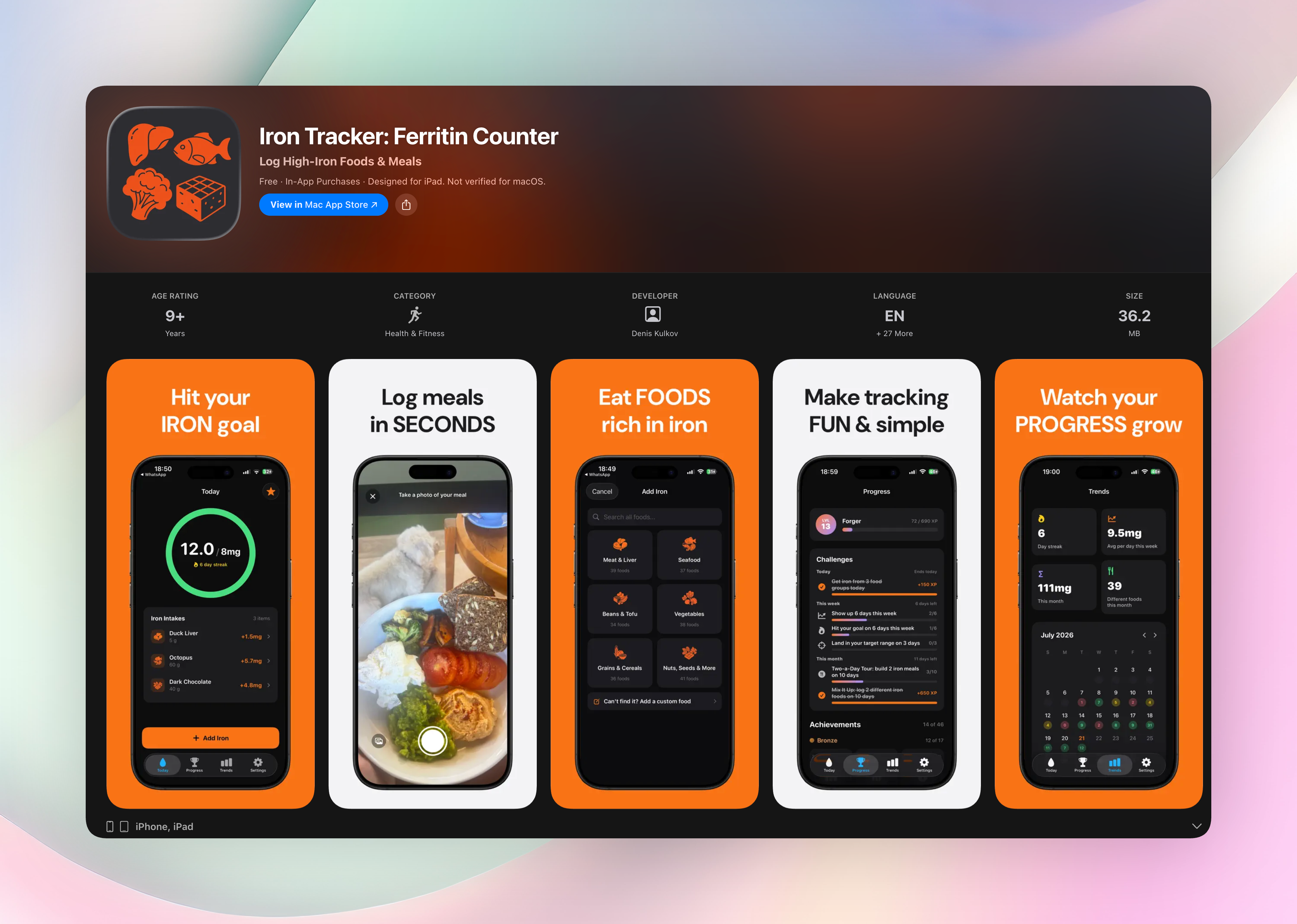
The entries that decide the day are the small ones — a slice of bread, a handful of cashews, a tablespoon of molasses — where a mental running total falls apart. Iron Tracker is an iron intake tracking app for iPhone, which handles that running total instead of leaving it to memory.
Three sample days that reach the numbers
Every value below comes straight from the table.
An 8 mg day, omnivore
- Breakfast: 2 eggs (1.8) + 2 slices whole wheat toast (1.8) + an orange (0.1)
- Lunch: 3 oz canned light tuna (1.3) on 2 slices whole wheat (1.8)
- Snack: ¼ cup raisins (0.8)
- Dinner: 3 oz sirloin (1.7) + 1 cup brown rice (1.1) + ½ cup broccoli (0.5)
Total: 10.9 mg, roughly 1.4 mg absorbed. Clears 8 mg with margin — the label total has to overshoot for the absorbed amount to land near what the RDA assumes.
An 18 mg day, omnivore
- Breakfast: 1 cup oatmeal (2.1) + 1 oz pumpkin seeds (2.5) + ½ cup strawberries (0.3)
- Lunch: 1 cup lentils (6.6) + 1 slice whole wheat bread (0.9) + ½ cup raw bell pepper (0.2)
- Dinner: 3 oz 85% ground beef (2.2) + ½ cup kidney beans (2.6) + 1 baked potato with skin (1.9)
Total: 19.3 mg, roughly 1.8 mg absorbed. Clears 18 mg on the label yet lands under the ~3.2 mg an 18% assumption implies — most of this iron is non-heme.
A plant-based day
- Breakfast: 1 cup oatmeal (2.1) + 1 oz pumpkin seeds (2.5) + ½ cup strawberries (0.3)
- Lunch: 1 cup chickpeas (4.7) + 1 cup quinoa (2.8) with lemon dressing
- Dinner: ½ cup firm tofu (3.4) + 1 cup cooked spinach with lemon (6.4) + 1 cup brown rice (1.1)
- Snack: 1 oz dark chocolate (3.4)
Total: 26.7 mg, roughly 1.9 mg absorbed. That clears the ~14 mg implied by 1.8× on an 8 mg RDA, but falls short of the ~32 mg it implies on an 18 mg one — reaching that from unfortified plant food alone is hard, which is why fortified cereal shows up in most plant-based menus built to that level. All three days sit well under the 45 mg upper limit.
These are published general guidelines, not a personal prescription — what any one person's iron status actually is belongs with a clinician and a blood test, not a food table.
FAQ
What are iron rich foods?
Two groups: heme sources like shellfish, red meat, organ meats, poultry, and fish; non-heme sources like beans, lentils, tofu, seeds, and fortified grains. Canned clams, oysters, and fortified cereal top the list per serving.
What food has the most iron per serving?
Canned clams, at about 23.8 mg per 3 oz drained — several times any other common food. Fortified cereal at 100% DV is next, at 18 mg.
Is it better to get iron from meat or from plants?
Heme absorbs faster and more predictably, and boosts non-heme absorption from the rest of the meal. Plants can match it with a higher total and a vitamin C source — the logic behind the 1.8× vegetarian RDA.
Does cooking in cast iron really add iron to food?
Yes, measurably. Acidic, high-moisture food simmered a long time in bare cast iron picks up the most iron; quick cooking transfers little.
How much iron is in spinach?
About 6.4 mg per cooked cup, though oxalate binds much of it, so the absorbed share runs low. Raw spinach runs closer to 0.8 mg per cup.
Free Iron tools
- Daily Iron RDA CalculatorEnter your age, sex, life stage and diet to see the published iron RDA, upper limit and vegetarian or vegan adjustment.
- Ferritin Change CalculatorCompare two ferritin test results with their dates and units to calculate the absolute change, percentage change and rate over time.
- Ferritin Unit ConverterEnter the ferritin value from your blood test and the unit your laboratory printed. The converter shows the same number in ng/mL, µg/L and pmol/L at once, with the standard adult reference ranges alongside it for comparison.
- Heme vs Non-Heme Iron ComparisonCompare heme vs non heme iron by entering the two amounts. See total iron and a clear percentage split for each form.
- Hemoglobin Unit ConverterHemoglobin lab test units are not the same everywhere. Enter the number on your report, pick the unit it is printed in, and convert hemoglobin g/dL to mmol/L or g/L — with the same value shown in all three units and the standard adult reference ranges beside it.
- Iron and Ferritin Level ChartPlot an iron or ferritin result against commonly used reference ranges. Choose the test, enter its value, and see whether it falls in the low, typical or high band.
- Iron-Rich Foods ChartCompare iron-rich foods by category, serving size and diet preference. See iron per serving, heme or non-heme type, and percent Daily Value.
- Iron-Rich Foods for Anemia ChartFilter a static food table by diet, serving size and iron type to compare iron per serving with preparation notes. This is a food reference, not a diagnosis.
- Iron Supplement Supply CalculatorEstimate how long a bottle lasts, its daily and 30-day cost, elemental iron per day and the date it runs out.
- MCH CalculatorEnter the hemoglobin value and red blood cell count from your blood test report. Get mean corpuscular hemoglobin (MCH) in picograms, plus where that number sits against the standard adult reference range of 27–33 pg. Nothing here is a diagnosis — lab results are interpreted by a clinician.
- Transferrin Saturation CalculatorEnter the serum iron and TIBC printed on your blood test and pick the unit they were reported in. Get transferrin saturation as a percentage, both values echoed in the other unit, and where the percentage falls against the published adult reference range.
- Vegetarian Iron Foods ChartCompare vegetarian iron sources by serving size, rank them by iron per portion, and see their contribution to your selected daily target.