
Best 7 Ruby Health Alternatives in 2026: Track Ferritin & Iron Smarter
We tested several Ruby Health alternatives, and Iron Tracker is the best app for tracking iron intake and ferritin levels. This guide covers other apps that log blood results, periods, anemia symptoms, or fibroid tracking. No filler, just tools that fit specific needs.
Quick comparison table
Scan this table to jump straight to the app that matches what you’re looking for.
| App | Best for | Platform | Price |
|---|---|---|---|
| Iron Tracker | Rebuilding ferritin without complicated meal logs | iOS | Paid |
| Blood Test Tracker Blood Buddy | Android users who want raw bloodwork trends | Android | Free (with ads) |
| Clue Period & Cycle Tracker | Science-backed cycle tracking that ties heavy periods to iron loss | iOS | Freemium |
| Flo Cycle & Period Tracker | Symptom breadth. You can log over 70 symptoms and moods. | Android | Freemium |
| Uterine Fibroids Journey | Tracking fibroid-related anemia and heavy bleeding in one place | Android | Free |
| BloodKnows - Health Tracker | Privacy-first blood test charting with no registration | iOS | Free |
| Period Tracker Period Calendar | A straightforward period logger with PMS and fertility advice | iOS | Free (with ads) |
1. Iron Tracker
Best for: rebuilding ferritin without complicated meal logs.
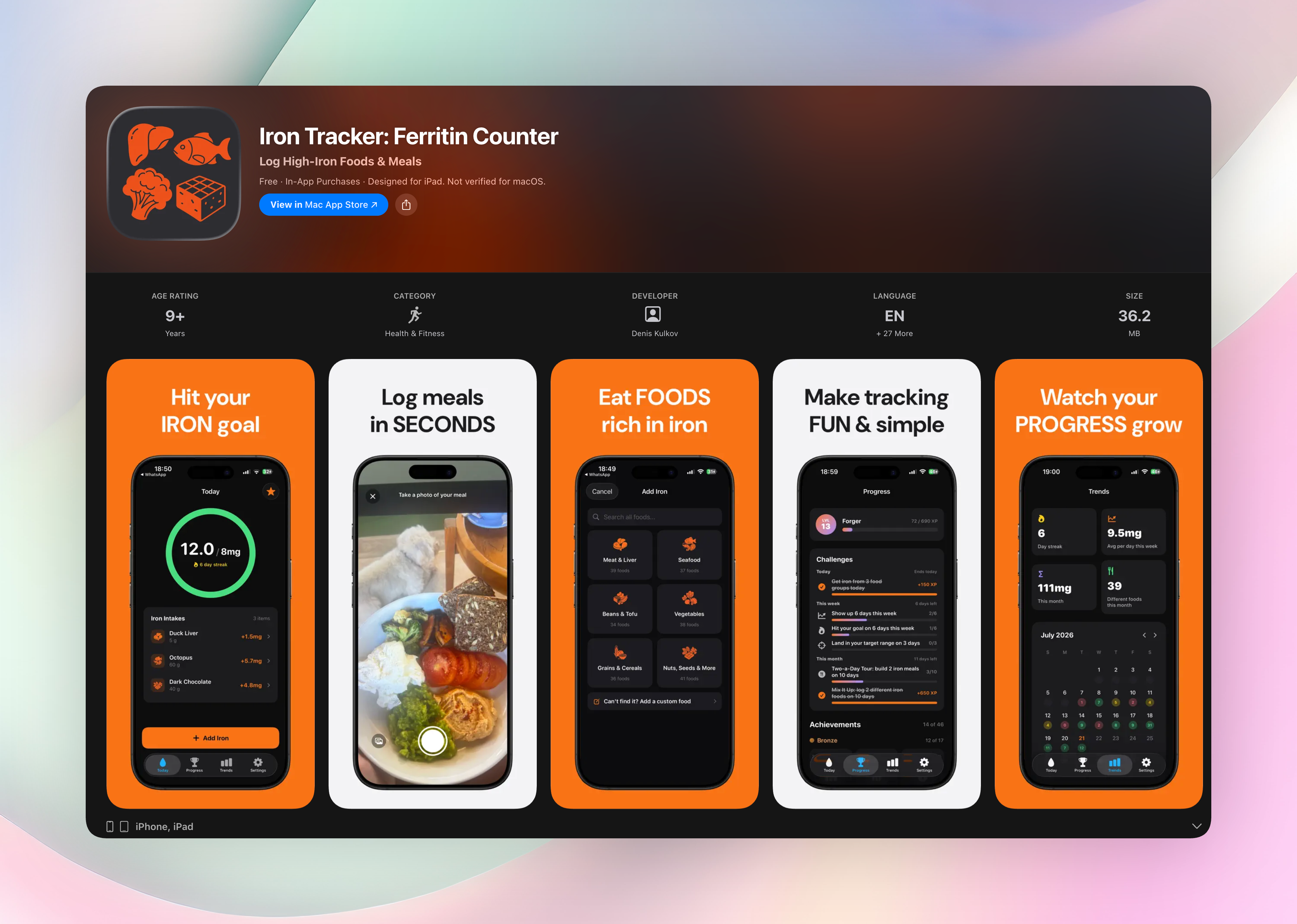
Iron Tracker strips iron tracking down to a daily goal and a simple log for food and supplements. You set your target using age, gender, and pregnancy status. Then you log meals from a database of 225 high-iron foods, or by photo, barcode, or voice with AI that you review before saving. The app separates heme and non-heme iron so you know what your body absorbs best.
The ferritin projection feature is a standout. It estimates how your levels might change over weeks based on your daily intake, giving you a rough trend line to check consistency. The app works entirely offline and never asks for an account, so you can start logging in seconds. Friendly reminders pop up just often enough to keep you on track without feeling pushy.
Unlike Ruby Health, this app skips the social feed and community chatter. You get just the numbers that matter when you’re trying to lift low iron. It’s built for anyone managing anemia, eating plant-based, or boosting levels before and during pregnancy.
- Set a daily iron target based on NIH guidelines.
- Quickly log foods and see a heme vs non-heme breakdown.
- Track progress with a clean ring, weekly calendar, and streaks.
- Earn XP, level up, and unlock 46 achievements for hitting your goal.
- Tackle daily, weekly, and monthly challenges to vary your iron sources.
- Everything runs on your device, with no ads and no data collection.
Get Iron Tracker to learn more, or grab Iron Tracker on the App Store and start logging today.
2. Blood Test Tracker Blood Buddy
Best for: Android users who want raw bloodwork trends.
This app lets you manually enter lab results and plots hemoglobin, ferritin, and other biomarkers on clean charts. Color-coded ranges flag when a value dips below normal, which is handy for spotting anemia indicators. You get a straightforward timeline of your numbers with no fluff. It’s a solid choice if you like seeing the data your doctor sees and tracking improvement between appointments.
3. Clue Period & Cycle Tracker
Best for: a science-backed cycle tracker that helps connect heavy periods to iron loss.
Clue logs bleeding heaviness alongside cycle length, cramps, and PMS. Its clean, non-pink interface puts pattern recognition front and center. It can surface months when blood loss was heavier and cross-reference that with energy dips, giving you context that’s useful when discussing ferritin with a provider. Trend analysis also covers PMS, skin, and sleep, so you see the full picture, not just dates.
4. Flo Cycle & Period Tracker
Best for: symptom breadth. You can log over 70 symptoms and moods.
Flo’s huge user base feeds its personalized insights, which can highlight heavy-bleeding cycles that may contribute to low iron. The app generates cycle reports you can share during a doctor visit. Input goes beyond bleeding to include cravings, discharge, and mood, so patterns tied to iron loss become easier to spot over time. It’s practical without being overwhelming.
5. Uterine Fibroids Journey
Best for: tracking fibroid-related anemia and heavy bleeding in one place.
This AI-powered app covers physical, emotional, and nutritional symptoms. That lets you log heavy menstrual bleeding and signs of anemia side by side. Few apps bundle those two problems together. The daily check-in asks relevant questions and builds a timeline that shows how bleeding severity, pain, and fatigue interact. That timeline is useful when you’re preparing for a consultation about fibroids.
6. BloodKnows - Health Tracker
Best for: a privacy-first blood tracker on iOS with no registration needed.
BloodKnows anonymizes your data and draws clean trend lines for ferritin, hemoglobin, and other biomarkers. You enter lab results manually and the app handles the charting without collecting personal details. It’s a good fit if you want lab-trend visibility without linking the information to an email or account, and the minimal interface makes it easy to spot changes over months.
7. Period Tracker Period Calendar
Best for: straightforward period logging with PMS and fertility advice.
This no-fuss calendar logs period start and end dates, daily moods, and symptoms like headache or low energy. While it doesn’t directly track iron, those low-energy days can hint at a pattern worth discussing with a doctor. It also predicts fertile windows and offers simple lifestyle tips, making it a practical, lightweight option for basic cycle awareness.
How we picked these apps
We focused on tools with direct relevance to iron, ferritin, or symptom tracking that affects iron status. Ease of use came next. If an app took more than a minute to log a meal or a lab value, it didn’t make the cut. We tested each app for at least a few days, ruling out any loaded with disruptive ads or unhelpful data. Privacy mattered too, so we favored apps that didn’t require an account or sell user data. Finally, we picked a mix of iOS and Android options so both camps get a solid Ruby Health alternative.
Frequently asked questions
What is Ruby Health and why are people looking for alternatives?
Ruby Health is a health-tracking app with community features. Many people look for Ruby Health alternatives because they want a tighter focus on iron, ferritin, and symptom logging, without the social feed and clutter.
Can these apps replace medical advice for low iron?
No. None of these apps diagnose or treat anemia. They’re logging companions that reveal patterns you can share with a healthcare provider so conversations about treatment are backed by real data.
Are these apps free or do they require subscriptions?
Iron Tracker uses a one-time purchase. Many others offer free tiers with optional premium features (Clue, Flo), a couple are fully free with ads (Blood Buddy, Period Tracker Period Calendar), and BloodKnows and Uterine Fibroids Journey are free without paywalls.
The verdict
If your target is low ferritin, Iron Tracker is the most direct way to log iron intake and see estimated progress. It cuts through the noise other apps layer on. No feeds, no account sign-ups, just your daily goal and a clear trend. Download Iron Tracker on the App Store and start rebuilding your levels today.
Free Iron tools
- Daily Iron RDA CalculatorEnter your age, sex, life stage and diet to see the published iron RDA, upper limit and vegetarian or vegan adjustment.
- Ferritin Change CalculatorCompare two ferritin test results with their dates and units to calculate the absolute change, percentage change and rate over time.
- Ferritin Unit ConverterEnter the ferritin value from your blood test and the unit your laboratory printed. The converter shows the same number in ng/mL, µg/L and pmol/L at once, with the standard adult reference ranges alongside it for comparison.
- Heme vs Non-Heme Iron ComparisonCompare heme vs non heme iron by entering the two amounts. See total iron and a clear percentage split for each form.
- Hemoglobin Unit ConverterHemoglobin lab test units are not the same everywhere. Enter the number on your report, pick the unit it is printed in, and convert hemoglobin g/dL to mmol/L or g/L — with the same value shown in all three units and the standard adult reference ranges beside it.
- Iron and Ferritin Level ChartPlot an iron or ferritin result against commonly used reference ranges. Choose the test, enter its value, and see whether it falls in the low, typical or high band.
- Iron-Rich Foods ChartCompare iron-rich foods by category, serving size and diet preference. See iron per serving, heme or non-heme type, and percent Daily Value.
- Iron-Rich Foods for Anemia ChartFilter a static food table by diet, serving size and iron type to compare iron per serving with preparation notes. This is a food reference, not a diagnosis.
- Iron Supplement Supply CalculatorEstimate how long a bottle lasts, its daily and 30-day cost, elemental iron per day and the date it runs out.
- MCH CalculatorEnter the hemoglobin value and red blood cell count from your blood test report. Get mean corpuscular hemoglobin (MCH) in picograms, plus where that number sits against the standard adult reference range of 27–33 pg. Nothing here is a diagnosis — lab results are interpreted by a clinician.
- Transferrin Saturation CalculatorEnter the serum iron and TIBC printed on your blood test and pick the unit they were reported in. Get transferrin saturation as a percentage, both values echoed in the other unit, and where the percentage falls against the published adult reference range.
- Vegetarian Iron Foods ChartCompare vegetarian iron sources by serving size, rank them by iron per portion, and see their contribution to your selected daily target.