
Does coffee block iron absorption? The mechanism and the timing rule
Yes — coffee blocks iron absorption, but only the non-heme iron in food eaten at the same time, and only while the drink and the meal are in your gut together. Black tea blocks more. The active compounds are polyphenols, not caffeine.
Does coffee block iron absorption? What the test meals show
Single-meal absorption studies, where a labeled test meal is fed and the iron crossing the gut wall is measured directly, consistently show coffee cutting non-heme iron uptake from that meal. Reported reductions generally land between roughly a third and two-thirds, depending on how much polyphenol ends up in the cup. Double-strength instant coffee sits at the harsh end, a weak short-brewed cup at the mild end. Research on coffee and iron absorption points to a dose relationship, not an on/off switch — brew strength matters far more than the bean or the roast.
Two things keep that from being alarming. A 60% cut is a percentage of a small number — healthy adults absorb only a modest fraction of the non-heme iron in a mixed meal anyway, and the body raises that fraction when stores run low. And it describes one meal, not one day: move coffee away from your iron-heavy meal and the rest of the day is untouched.
Polyphenols do the blocking; caffeine is a bystander
The responsible compounds are phenolic acids and tannins. Coffee's is chlorogenic acid. Black tea's are galloyl-group tannins — the theaflavins and thearubigins formed during oxidation. Green tea and matcha bring catechins, chiefly EGCG.
They all work the same way: in the intestinal lumen the polyphenol binds the iron into a complex too insoluble to be absorbed, so it leaves in the stool instead of crossing the gut wall through the DMT1 transporter.
Caffeine is not part of that reaction, which is where most of the confusion about caffeine and iron absorption comes from. Decaf still inhibits, because decaffeination strips the caffeine and leaves the chlorogenic acid. A caffeine tablet with no plant phenolics does essentially nothing to the iron in your lunch; a cup of decaf does plenty.
Coffee, tea, matcha, and herbal infusions by inhibition strength
| Drink | Main polyphenols | Effect on non-heme iron in the same meal | What changes it |
|---|---|---|---|
| Strong black tea | Tannins (theaflavins, thearubigins) | Strongest of the everyday drinks | Steep time |
| Matcha | Catechins, whole leaf | Strong | Powder dose per cup |
| Coffee (regular or decaf) | Chlorogenic acid | Substantial | Brew strength and volume |
| Steeped green tea | Catechins | Moderate to strong | Steep time and leaf quantity |
| Peppermint, chamomile and similar infusions | Mixed phenolics | Mild to moderate | Varies widely by plant |
| Rooibos | Very low tannin | Minimal | The usual pick at an iron-rich meal |
Steep time is the lever you control on tea and iron absorption — the same leaves pulled at two minutes instead of five deliver a much smaller tannin load. On matcha and iron absorption, the whole-leaf format is why it outranks steeped green tea: you drink the leaf itself, not an extract of it.
Heme iron barely notices
Polyphenols block non-heme iron — the form in beans, lentils, tofu, spinach, nuts, fortified cereal, and most supplements. Heme iron, bound inside the hemoglobin and myoglobin of red meat, poultry and fish, is taken up by a different route and is largely untouched by coffee or tea. If most of your iron arrives with meat, this is close to academic. If it arrives with plants, it isn't — which makes the split between heme and non-heme iron in your diet the best predictor of how much this matters.
The timing rule, if you're not giving up your morning cup
Inhibition is a contact effect: the polyphenols have to be in the gut at the same time as the iron. That makes timing the whole game.
- About an hour before the meal: little to no measurable effect. The stomach has largely emptied by the time food arrives.
- With the meal, or shortly after it: full effect. Drinking it afterward rescues nothing, because the meal is still sitting there.
- An hour or more after eating: the effect fades. Two hours is a comfortable margin.
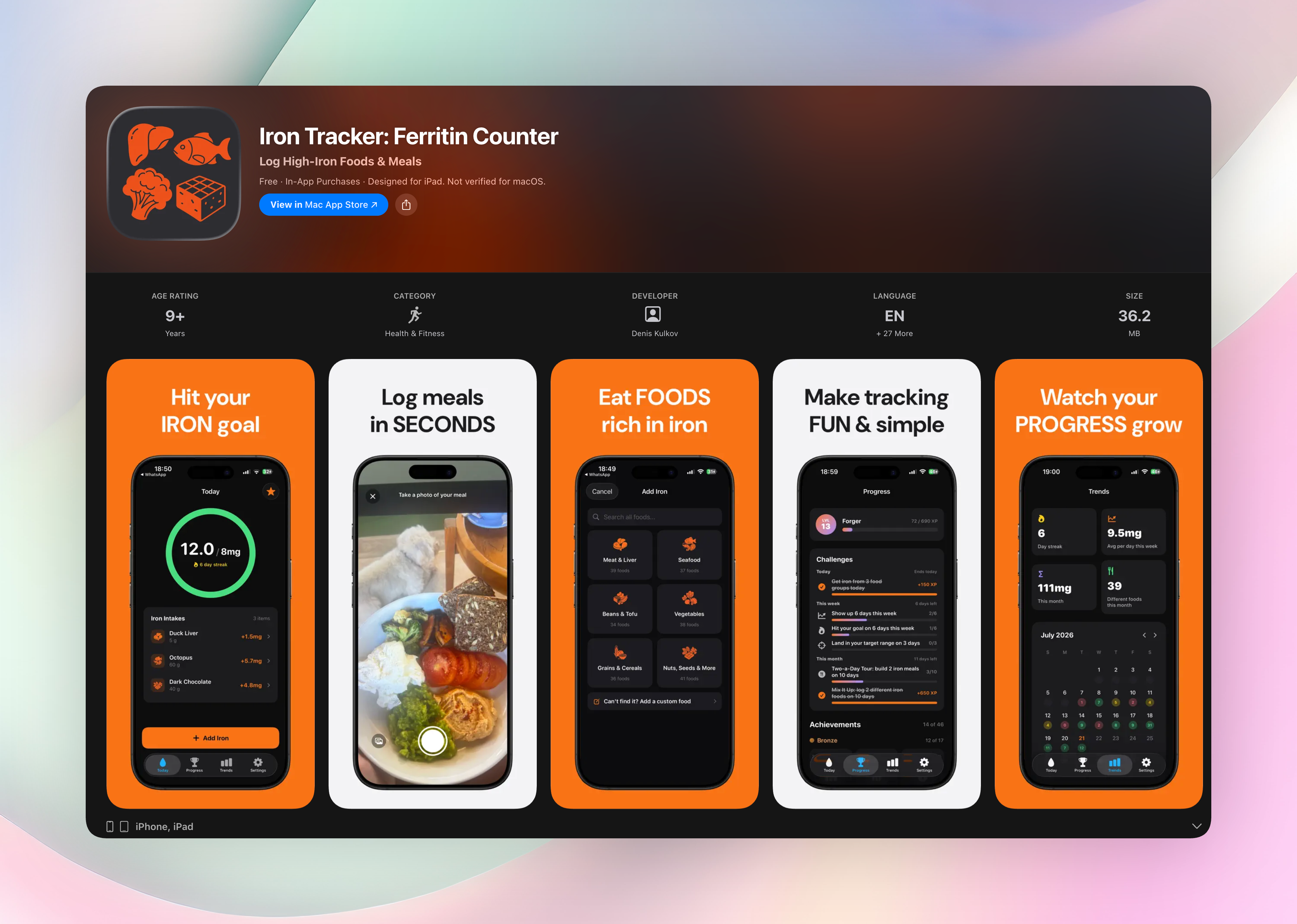
So the workable rule is one hour before or two hours after the meals that carry your iron — not abstinence. The adjustment is usually smaller than people expect: pull the first cup forward of breakfast, or move the lentils to dinner. The hard part is knowing which meals are the iron-heavy ones. Iron Tracker, an iron intake tracking app for iPhone, keeps that log, so you can see which meals are worth protecting from the coffee window.
What blunts the block
Vitamin C is the strongest counter-move. Ascorbic acid reduces ferric iron to the ferrous form and keeps it soluble, which partly overrides polyphenol binding — useful when the drink and the meal can't be separated, though a big polyphenol load needs a big dose to match it. More in vitamin C and iron absorption.
Weaker brews and shorter steeps help. Milk doesn't: it neither neutralizes tannins nor helps the iron, and the calcium it adds is a separate inhibitor, so a latte at the meal is two problems instead of one. Polyphenols are one entry on a longer list that includes calcium, phytates, and certain medications — the full set is in what blocks iron absorption.
Who needs to care about this
For an iron-replete adult on a mixed diet, coffee at meals is a small nudge the body largely corrects for on its own — absorption efficiency climbs as stores fall. The margin is thinner for vegetarians and vegans, whose iron is entirely non-heme; for people who menstruate or are pregnant; for frequent blood donors; and for anyone with low ferritin.
For context, NIH reference intakes are 8 mg a day for adult men and for women 51 and over, 18 mg a day for women 19–50, and 27 mg during pregnancy, with a note that people eating no meat may need roughly 1.8 times those amounts. Those are general population guidelines, not personal targets — if you're managing a diagnosed deficiency, timing questions belong with the clinician who ordered your labs.
FAQ
Does decaf coffee still block iron absorption?
Yes. Decaffeination removes caffeine and leaves chlorogenic acid, the compound that actually binds the iron. Decaf brewed to the same strength behaves much like regular coffee at the same meal.
Does tea affect iron absorption more than coffee?
Strong black tea is generally the most inhibitory of the everyday drinks, ahead of coffee. But steep time swamps the category difference — a briefly steeped tea can be gentler than a double-strength coffee.
How long should I wait to drink coffee after an iron supplement?
Two hours is the commonly used margin. Taking the supplement at least an hour after your last cup works on the same logic, since inhibition only happens when both are in the gut together.
Does adding milk to coffee or tea reduce the effect on iron?
No. Milk doesn't bind the tannins in any useful way, and calcium is an iron absorption inhibitor on its own, so it doesn't improve the situation.
Is matcha worse than regular green tea for iron?
Per cup, usually. Matcha is powdered whole leaf rather than an infusion, so you get the full catechin content instead of whatever leaches out during a short steep.
Free Iron tools
- Daily Iron RDA CalculatorEnter your age, sex, life stage and diet to see the published iron RDA, upper limit and vegetarian or vegan adjustment.
- Ferritin Change CalculatorCompare two ferritin test results with their dates and units to calculate the absolute change, percentage change and rate over time.
- Ferritin Unit ConverterEnter the ferritin value from your blood test and the unit your laboratory printed. The converter shows the same number in ng/mL, µg/L and pmol/L at once, with the standard adult reference ranges alongside it for comparison.
- Heme vs Non-Heme Iron ComparisonCompare heme vs non heme iron by entering the two amounts. See total iron and a clear percentage split for each form.
- Hemoglobin Unit ConverterHemoglobin lab test units are not the same everywhere. Enter the number on your report, pick the unit it is printed in, and convert hemoglobin g/dL to mmol/L or g/L — with the same value shown in all three units and the standard adult reference ranges beside it.
- Iron and Ferritin Level ChartPlot an iron or ferritin result against commonly used reference ranges. Choose the test, enter its value, and see whether it falls in the low, typical or high band.
- Iron-Rich Foods ChartCompare iron-rich foods by category, serving size and diet preference. See iron per serving, heme or non-heme type, and percent Daily Value.
- Iron-Rich Foods for Anemia ChartFilter a static food table by diet, serving size and iron type to compare iron per serving with preparation notes. This is a food reference, not a diagnosis.
- Iron Supplement Supply CalculatorEstimate how long a bottle lasts, its daily and 30-day cost, elemental iron per day and the date it runs out.
- MCH CalculatorEnter the hemoglobin value and red blood cell count from your blood test report. Get mean corpuscular hemoglobin (MCH) in picograms, plus where that number sits against the standard adult reference range of 27–33 pg. Nothing here is a diagnosis — lab results are interpreted by a clinician.
- Transferrin Saturation CalculatorEnter the serum iron and TIBC printed on your blood test and pick the unit they were reported in. Get transferrin saturation as a percentage, both values echoed in the other unit, and where the percentage falls against the published adult reference range.
- Vegetarian Iron Foods ChartCompare vegetarian iron sources by serving size, rank them by iron per portion, and see their contribution to your selected daily target.