
What is ferritin, and what does it do?
Ferritin is the protein that stores iron inside your cells. Each molecule is a hollow shell that locks thousands of iron atoms away in a stable, non-reactive form and releases them when the body needs them. The ferritin measured in a blood test is the standard proxy for how much iron you have banked.
What is ferritin made of?
A single ferritin molecule is built from 24 protein subunits that assemble into a hollow sphere about 12 nanometers across, with a cavity roughly 8 nanometers wide. The empty shell is called apoferritin. Inside it, iron is deposited as ferrihydrite — a mineral of iron oxide and phosphate — and a fully loaded shell holds on the order of 4,500 iron atoms, though most carry far less.
The shell mixes two subunit types, H (heavy) and L (light), in proportions that vary by tissue — heart and brain ferritin is H-rich, liver and spleen ferritin L-rich. H subunits carry ferroxidase activity: they oxidize incoming ferrous iron (Fe²⁺) to ferric iron (Fe³⁺), the form that precipitates into the mineral core. L subunits help nucleate and stabilize it.
The chemistry is the point. Loose ferrous iron catalyzes hydroxyl radical formation from hydrogen peroxide, damaging lipids, proteins, and DNA. Ferritin keeps the reserve inert but retrievable — storage and safety in one structure.
What ferritin does: the body's iron buffer
Ferritin function is best understood as buffering. Supply arrives from the diet and from recycled red blood cells; demand rises and falls with red cell production, growth, pregnancy, and blood loss. Ferritin absorbs the mismatch — when supply runs ahead, cells make more of it and salt the surplus away; when demand runs ahead, stored iron is mobilized back out.
Most of the reserve sits in liver hepatocytes and in macrophages of the spleen, liver, and bone marrow. Macrophages are the busiest handlers — they engulf worn-out red cells, strip iron out of hemoglobin, and either bank it in ferritin or export it through ferroportin onto transferrin, the carrier that moves iron through plasma. Some ferritin is eventually degraded in lysosomes into hemosiderin, a dense iron-protein aggregate that is real storage but is mobilized far more sluggishly.
The traffic controller is hepcidin, a liver hormone that binds ferroportin and takes it out of service, blocking both iron absorption in the gut and iron release from macrophages. Hepcidin rises when stores are ample and during inflammation, and falls when the body needs iron.
Iron storage in the body: where the 3–4 grams sit
An adult carries roughly 3–4 grams of iron in total, typically nearer 4 g in men and closer to 3 g or less in premenopausal women, distributed unevenly:
- Hemoglobin — about 2 to 2.5 g, by far the largest share, circulating in red blood cells.
- Stored ferritin and hemosiderin — on the order of 1 g in many men, often only a few hundred milligrams in premenopausal women, since menstruation removes iron every cycle.
- Myoglobin and enzymes — a few hundred milligrams in muscle and in iron-dependent enzymes.
- Transferrin-bound iron in plasma — only about 3 to 4 milligrams at any instant.
That last figure is the surprising one. The circulating pool is a few milligrams, yet roughly 20 to 25 mg of iron passes through it daily, nearly all recycled from aging red cells. Plasma iron turns over many times a day; the reserve behind it is measured in grams.
Ferritin vs serum iron
The ferritin vs serum iron distinction matters because the two tests answer different questions. Serum iron measures what is bound to transferrin at the instant blood was drawn; the ferritin test estimates the reserve behind it.
Serum iron is volatile. It follows a diurnal pattern — generally higher in the morning, lower later in the day — and an iron-containing meal or supplement can lift it for hours. Two draws from the same healthy person on one day can differ substantially. Serum iron is therefore rarely read alone; it is paired with total iron-binding capacity to compute transferrin saturation.
Circulating ferritin is different in kind. Cells secrete a small amount into plasma, mostly L-rich and relatively iron-poor, and when inflammation is absent that amount tracks the size of the store.
| Serum ferritin | Serum iron | |
|---|---|---|
| What it reflects | Size of the stored reserve | Iron on transferrin at that moment |
| Scale involved | Hundreds of milligrams to grams | About 3–4 mg in the whole bloodstream |
| Stability | Moves over weeks to months | Swings within a single day |
| Shifted by a recent meal | Not meaningfully | Yes, for hours |
| Commonly confounded by | Inflammation, infection, liver disease | Time of day, recent intake, acute illness |
Neither number is self-interpreting, and reference intervals differ by laboratory, assay, age, and sex. Reading a result belongs to the clinician who ordered the test.
Why iron stores move over weeks, not meals
Absorption is the bottleneck. A healthy adult absorbs only about 1–2 mg of iron a day, roughly matching what is lost through shed skin and gut cells, with menstrual losses on top. Against the 20–25 mg recycled internally each day, diet is a trickle topping up a system that mostly runs on its own recycling.
Absorption efficiency is not fixed either. Heme iron from meat, poultry, and fish uses a different uptake route and is absorbed more efficiently than non-heme iron from plants, and non-heme uptake shifts with the rest of the plate — vitamin C helps, while phytates, polyphenols, and calcium hinder. Hepcidin damps the system further: when stores are replete, absorption is suppressed regardless of how much iron the meal contained.
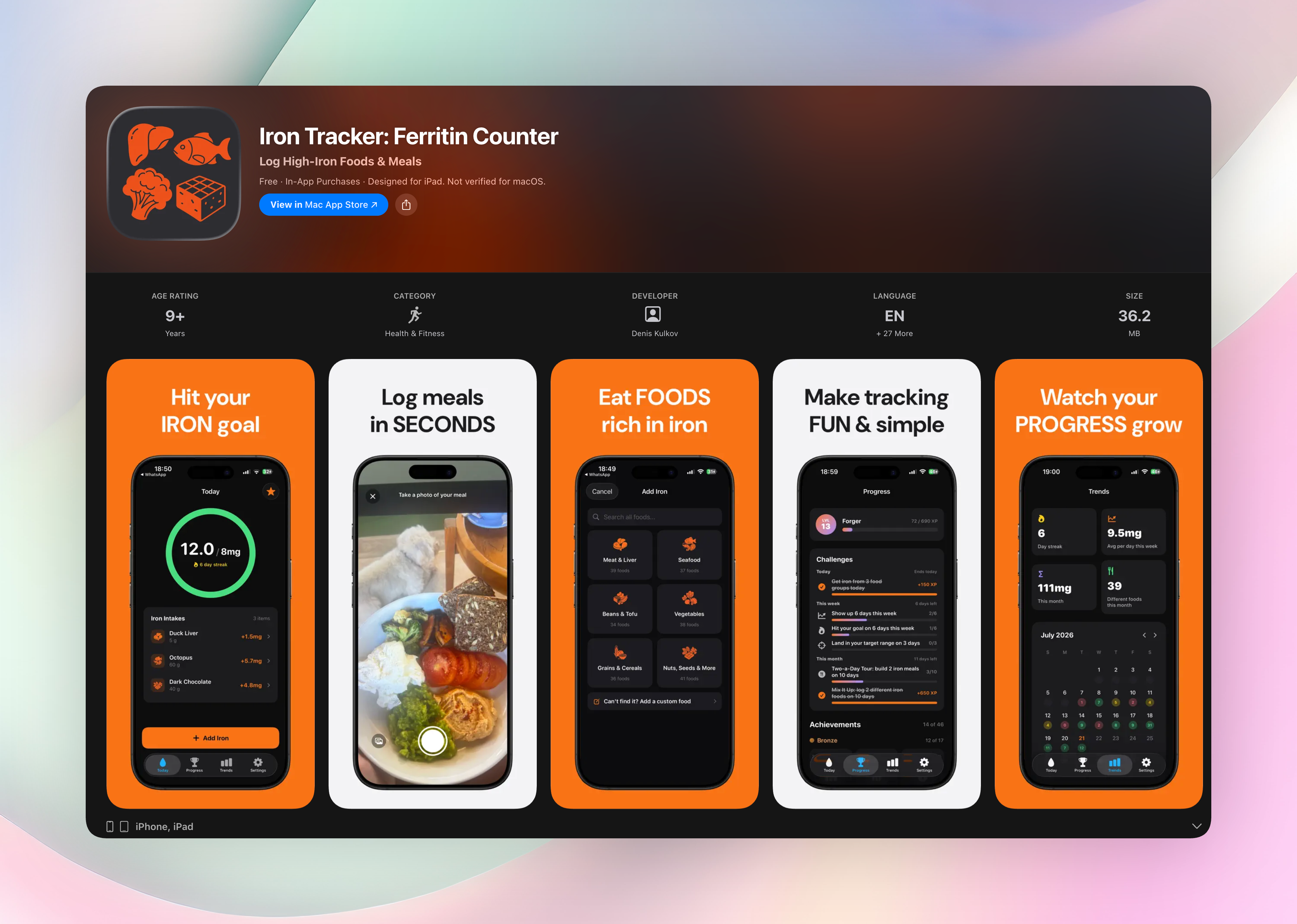
A single high-iron dinner therefore barely registers against a multi-gram reserve. What moves stores is the sustained average — milligrams taken in week after week from iron rich foods or supplements, set against ongoing losses. The NIH publishes general RDAs as the population reference point: 8 mg/day for adult men and for women 51 and older, 18 mg/day for women 19–50, and 27 mg/day in pregnancy. Those are general guidelines, not personal prescriptions. Seeing your own week-over-week average beats guessing at it, and Iron Tracker is an iron intake tracking app for iPhone.
Red cell turnover sets the other clock. Red blood cells live about 120 days, so a shift in the balance between intake, losses, and production takes weeks to register in the reserve and months to play out. For how targets differ across age and sex, see how much iron per day.
Ferritin also responds to inflammation
Ferritin is an acute-phase reactant. Infection, chronic inflammatory disease, liver disease, heavy alcohol use, and some cancers can all raise the circulating level independently of stored iron. The rise is real: the body makes more ferritin during inflammation, partly to keep iron away from pathogens. It just stops tracking the reserve.
That is why the test is often ordered alongside an inflammatory marker such as CRP, or with transferrin saturation, which behaves differently under inflammation.
FAQ
What does ferritin do?
It stores iron in a stable, non-reactive form and releases it on demand, keeping loose iron out of the cytoplasm where it would drive the production of damaging free radicals. Iron is the element; ferritin is the protein that holds it.
What is the difference between ferritin and serum iron?
Serum iron is the iron riding on transferrin at that moment — only about 3–4 mg across the whole bloodstream, and it swings within a single day. The ferritin level estimates the reserve, which runs from hundreds of milligrams to grams and shifts over weeks. The two can move in different directions, which is why they are read together.
Can ferritin be high without high iron stores?
Yes. Because ferritin is an acute-phase reactant, inflammation, infection, liver disease, and heavy alcohol use can raise it independently of stored iron. Clinicians account for that with inflammatory markers or transferrin saturation.
How quickly does ferritin change?
Slowly — over weeks to months. Daily absorption is only about 1–2 mg against a total body iron pool of 3–4 grams, and red cells live about 120 days, so no single meal moves the number.
Free Iron tools
- Daily Iron RDA CalculatorEnter your age, sex, life stage and diet to see the published iron RDA, upper limit and vegetarian or vegan adjustment.
- Ferritin Change CalculatorCompare two ferritin test results with their dates and units to calculate the absolute change, percentage change and rate over time.
- Ferritin Unit ConverterEnter the ferritin value from your blood test and the unit your laboratory printed. The converter shows the same number in ng/mL, µg/L and pmol/L at once, with the standard adult reference ranges alongside it for comparison.
- Heme vs Non-Heme Iron ComparisonCompare heme vs non heme iron by entering the two amounts. See total iron and a clear percentage split for each form.
- Hemoglobin Unit ConverterHemoglobin lab test units are not the same everywhere. Enter the number on your report, pick the unit it is printed in, and convert hemoglobin g/dL to mmol/L or g/L — with the same value shown in all three units and the standard adult reference ranges beside it.
- Iron and Ferritin Level ChartPlot an iron or ferritin result against commonly used reference ranges. Choose the test, enter its value, and see whether it falls in the low, typical or high band.
- Iron-Rich Foods ChartCompare iron-rich foods by category, serving size and diet preference. See iron per serving, heme or non-heme type, and percent Daily Value.
- Iron-Rich Foods for Anemia ChartFilter a static food table by diet, serving size and iron type to compare iron per serving with preparation notes. This is a food reference, not a diagnosis.
- Iron Supplement Supply CalculatorEstimate how long a bottle lasts, its daily and 30-day cost, elemental iron per day and the date it runs out.
- MCH CalculatorEnter the hemoglobin value and red blood cell count from your blood test report. Get mean corpuscular hemoglobin (MCH) in picograms, plus where that number sits against the standard adult reference range of 27–33 pg. Nothing here is a diagnosis — lab results are interpreted by a clinician.
- Transferrin Saturation CalculatorEnter the serum iron and TIBC printed on your blood test and pick the unit they were reported in. Get transferrin saturation as a percentage, both values echoed in the other unit, and where the percentage falls against the published adult reference range.
- Vegetarian Iron Foods ChartCompare vegetarian iron sources by serving size, rank them by iron per portion, and see their contribution to your selected daily target.