How much iron per day you need, by age and sex
How much iron per day you need depends mostly on age, sex, and whether you menstruate. The US RDA is 8 mg for adult men, 18 mg for women aged 19–50, and 27 mg during pregnancy. Everything else is a variation on those three numbers.
How much iron per day, by age and sex
The recommended daily iron intake figures below come from the Dietary Reference Intakes set by the National Academies and published by the NIH Office of Dietary Supplements. An RDA is a population figure — the intake that covers the needs of about 97–98% of healthy people in that group, averaged over time. It isn't a quota you fail by missing on a Tuesday, and it isn't a personal prescription.
| Life stage | Male | Female | Pregnancy | Lactation |
|---|---|---|---|---|
| Birth–6 months | 0.27 mg* | 0.27 mg* | — | — |
| 7–12 months | 11 mg | 11 mg | — | — |
| 1–3 years | 7 mg | 7 mg | — | — |
| 4–8 years | 10 mg | 10 mg | — | — |
| 9–13 years | 8 mg | 8 mg | — | — |
| 14–18 years | 11 mg | 15 mg | 27 mg | 10 mg |
| 19–50 years | 8 mg | 18 mg | 27 mg | 9 mg |
| 51+ years | 8 mg | 8 mg | — | — |
*Adequate Intake rather than an RDA — there's no RDA set for infants under seven months.
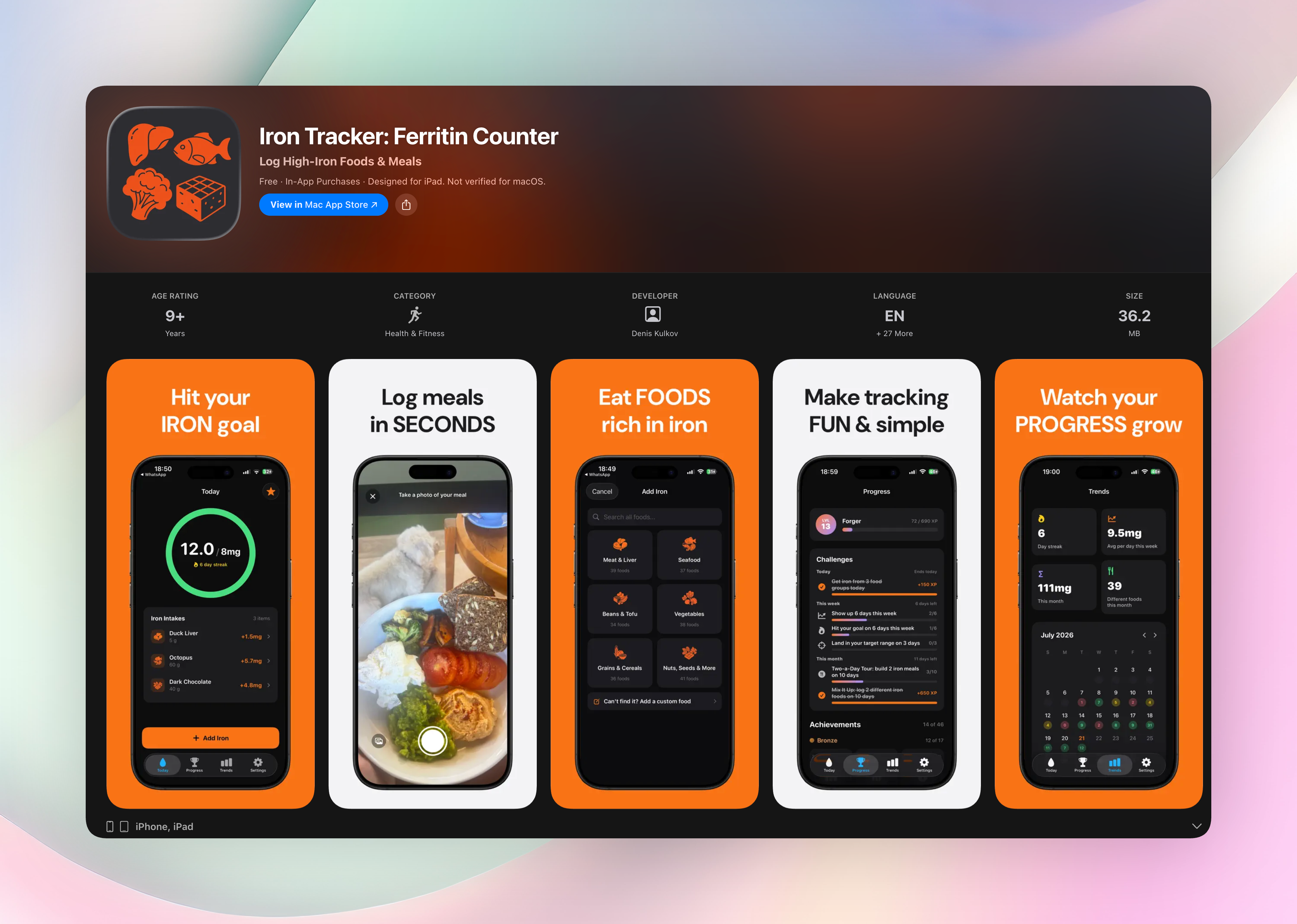
Once you've found your row, the next question is whether an ordinary day of eating lands anywhere near it, and most people guess wrong in one direction or the other. Iron Tracker is an iron intake tracking app for iPhone, which takes the arithmetic out of adding up a few real days.
Why the number more than doubles between 13 and 19
At ages 9–13 the RDA for iron is 8 mg for everyone. At 14–18 it splits: 11 mg for males, covering the demands of rapid growth and expanding blood volume, and 15 mg for females, which stacks menstrual losses on top of that growth. Once growth finishes, males settle back to 8 mg while females stay high — 18 mg all the way through age 50.
The 51+ bracket returns women to 8 mg because the guideline assumes menopause has ended monthly losses. That's an age bracket, not a diagnosis. Someone who reaches menopause at 45 and someone still menstruating at 54 both sit outside the assumption, and published brackets can't tell them apart.
Pregnancy carries the largest jump, to 27 mg, driven by maternal blood volume expansion plus the iron transferred to the fetus and placenta. Lactation is listed lower — 9 mg for ages 19–50 — largely because menstruation is often suppressed while breastfeeding, and the iron lost in milk is small.
How much iron is too much? The 45 mg upper limit
The Tolerable Upper Intake Level for iron is 45 mg per day for everyone aged 14 and up, including during pregnancy, and 40 mg per day from birth through age 13.
Two things about that number get misread constantly.
First, the adult upper limit is built on gastrointestinal effects — constipation, nausea, cramping, dark stools — not on organ damage. It marks the point where unpleasant becomes likely, not where harm begins.
Second, in practice it's a supplement number. Iron absorption is actively regulated: when body stores are full, the intestine takes up far less of what passes through. Reaching 45 mg from unfortified food alone is difficult. Reaching it from a single capsule is trivial. The upper limit also doesn't apply to people taking prescribed iron under medical supervision, where larger doses are used deliberately and monitored.
Two groups sit outside its logic entirely. People with hereditary hemochromatosis absorb iron without the normal brake, so a ceiling drawn for the general population doesn't protect them. And young children can be acutely poisoned by adult iron products — accidental overdose is a documented cause of poisoning deaths in children under six, which is why US supplement labels carry a mandated warning to keep them out of reach.
The 18 mg on nutrition labels is not your target
The FDA's Daily Value for iron is 18 mg for adults and children 4 and older. One number, one label, everybody.
That figure sits near the high end of the range on purpose, so the label doesn't understate the needs of the group that needs the most. The consequence is that %DV rarely matches anyone's actual daily iron intake target:
- An adult man eating 100% DV is at roughly 225% of his 8 mg guideline.
- A woman aged 19–50 at 100% DV lands exactly on hers — the one case where the label works.
- A pregnant reader at 100% DV is at about two-thirds of her 27 mg figure.
%DV is a way to compare two cereals in the same aisle, not a personal scoreboard. A food listing 10% DV contains 1.8 mg of iron, and that milligram figure is the one worth writing down.
Milligrams on a label aren't milligrams absorbed
Two forms of iron reach the gut. Heme iron, from meat, poultry, and seafood, is absorbed efficiently and is largely unbothered by the rest of the meal. Non-heme iron — from plants, eggs, fortified grains, and every supplement sold as a ferrous salt — is absorbed far less efficiently and is pushed around by whatever it's eaten with. Vitamin C raises non-heme absorption; the polyphenols in tea and coffee, phytates in whole grains and legumes, and large calcium doses lower it.
The rough figures cited by the NIH: people absorb roughly 14–18% of iron from mixed diets that include meat and vitamin C, and roughly 5–12% from vegetarian diets. That gap is why the National Academies suggest vegetarians and vegans aim for 1.8 times the standard figure — about 14 mg for adult men and 32 mg for women aged 19–50. Building meals around the denser iron rich foods and pairing them with a vitamin C source moves the needle more than chasing a raw milligram total.
One last label trap: supplement bottles often print the weight of the compound, not the iron. A 325 mg ferrous sulfate tablet supplies about 65 mg of elemental iron. The "elemental iron" line is the one that counts against the 45 mg ceiling.
FAQ
How many mg of iron per day is right for an adult woman?
18 mg per day from ages 19 through 50, then 8 mg from 51 on. The higher figure covers menstrual losses, and the drop at 51 assumes menopause. Pregnancy raises the guideline to 27 mg; lactation lowers it to 9 mg.
How much iron do I need a day if I don't eat meat?
The National Academies suggest multiplying the RDA for iron by 1.8, since non-heme iron is absorbed less efficiently — roughly 14 mg for adult men and 32 mg for women aged 19–50. Pairing plant sources with vitamin C narrows the absorption gap.
Is 65 mg of iron a day too much?
It's above the 45 mg upper limit set for adults, which is based on gastrointestinal effects rather than organ damage. That figure is also the elemental iron in one standard 325 mg ferrous sulfate tablet — a common over-the-counter dose, not something reserved for supervised or prescription use.
Can you get too much iron from food alone?
It's uncommon. Absorption drops as body stores fill, and unfortified foods are dilute enough that ordinary eating rarely approaches 45 mg. Heavily fortified products and supplements are where intake stacks up fast.
Does hitting 100% DV mean I've met my iron guideline?
Only if your figure happens to be 18 mg. The Daily Value is a single label number for everyone 4 and older, so 100% DV sits well above an adult man's 8 mg and well below a pregnant woman's 27 mg.
Free Iron tools
- Daily Iron RDA CalculatorEnter your age, sex, life stage and diet to see the published iron RDA, upper limit and vegetarian or vegan adjustment.
- Ferritin Change CalculatorCompare two ferritin test results with their dates and units to calculate the absolute change, percentage change and rate over time.
- Ferritin Unit ConverterEnter the ferritin value from your blood test and the unit your laboratory printed. The converter shows the same number in ng/mL, µg/L and pmol/L at once, with the standard adult reference ranges alongside it for comparison.
- Heme vs Non-Heme Iron ComparisonCompare heme vs non heme iron by entering the two amounts. See total iron and a clear percentage split for each form.
- Hemoglobin Unit ConverterHemoglobin lab test units are not the same everywhere. Enter the number on your report, pick the unit it is printed in, and convert hemoglobin g/dL to mmol/L or g/L — with the same value shown in all three units and the standard adult reference ranges beside it.
- Iron and Ferritin Level ChartPlot an iron or ferritin result against commonly used reference ranges. Choose the test, enter its value, and see whether it falls in the low, typical or high band.
- Iron-Rich Foods ChartCompare iron-rich foods by category, serving size and diet preference. See iron per serving, heme or non-heme type, and percent Daily Value.
- Iron-Rich Foods for Anemia ChartFilter a static food table by diet, serving size and iron type to compare iron per serving with preparation notes. This is a food reference, not a diagnosis.
- Iron Supplement Supply CalculatorEstimate how long a bottle lasts, its daily and 30-day cost, elemental iron per day and the date it runs out.
- MCH CalculatorEnter the hemoglobin value and red blood cell count from your blood test report. Get mean corpuscular hemoglobin (MCH) in picograms, plus where that number sits against the standard adult reference range of 27–33 pg. Nothing here is a diagnosis — lab results are interpreted by a clinician.
- Transferrin Saturation CalculatorEnter the serum iron and TIBC printed on your blood test and pick the unit they were reported in. Get transferrin saturation as a percentage, both values echoed in the other unit, and where the percentage falls against the published adult reference range.
- Vegetarian Iron Foods ChartCompare vegetarian iron sources by serving size, rank them by iron per portion, and see their contribution to your selected daily target.