Vitamin C and iron absorption: how to pair them in a single meal
Vitamin C and iron absorption are linked by one chemical step. Ascorbic acid reduces ferric iron to the ferrous form your gut can actually take up, and keeps it dissolved. In the same meal, it can multiply non-heme iron absorption several-fold; taken an hour later, it does almost nothing.
Why vitamin C and iron absorption are linked
Most of the iron in plants, eggs, and fortified foods is non-heme, and much of it arrives as ferric iron (Fe³⁺). The transporter that carries iron into the intestinal cell, DMT1, only moves ferrous iron (Fe²⁺); a brush-border enzyme, duodenal cytochrome b, handles some of that conversion but it's a bottleneck.
Ascorbic acid works on the problem twice: it donates an electron, reducing Fe³⁺ to Fe²⁺, and it binds iron in a soluble complex that survives the shift from stomach acid to the near-neutral duodenum, where unchelated ferric iron would otherwise precipitate as insoluble hydroxide and pass straight through.
Heme iron from meat, poultry, and fish takes a different route — the intact heme molecule is absorbed whole — which is why it starts at roughly 15–35% absorption and why vitamin C barely moves it.
How much vitamin C increases iron absorption
The response is dose-dependent and roughly logarithmic — each doubling adds less than the one before it. The useful anchor is the molar ratio of ascorbic acid to iron: around 4:1 shows a solid effect in single-meal studies, which works out to about 12–13 mg of vitamin C per mg of non-heme iron on the plate — roughly 60–65 mg beside a 5 mg-iron bowl.
Rough shape of the curve per meal:
- ~25 mg — a measurable bump, not much more.
- ~50 mg — commonly two- to three-fold on an ordinary plant-based meal.
- ~100 mg — the practical ceiling for most meals; more only earns its keep when phytate is heavy.
- Past ~200 mg — little further gain, and vitamin C's own absorption efficiency is already falling.
Percentages sound bigger than the milligrams behind them: tripling a 3% absorption rate gets you 9%, real but still a small slice of the number on the label.
The effect is clean in single-meal studies; longer trials over weeks are less consistent, partly because the gut turns absorption down as stores fill — the pairing matters most when stores are low.
Timing: same meal, not the same day
The mechanism is luminal — it happens in the gut, not the bloodstream, so ascorbic acid has to be sitting in the duodenum at the same moment as the iron. Swallowing it two hours after lunch is chemically irrelevant to that lunch.
The practical version:
- Same plate, or same sitting. Fruit for dessert still counts. A smoothie three hours later doesn't.
- Heat and oxygen degrade ascorbic acid. Boiling leaches it into the water and a long simmer destroys much of the rest, so raw sources deliver far more than their cooked versions.
- Cut close to eating. Exposed surfaces and days in the fridge both cost vitamin C.
Vitamin C rich foods for iron absorption
Approximate amounts for raw servings; cooking lowers every one.
| Food | Serving | Vitamin C | Where it fits |
|---|---|---|---|
| Red bell pepper, raw | 1 cup chopped (~150 g) | ~190 mg | lentil and bean bowls |
| Guava | 1 fruit (~55 g) | ~125 mg | eaten alongside |
| Orange juice | 1 cup (240 ml) | ~120 mg | fortified cereal |
| Strawberries | 1 cup halved (~150 g) | ~90 mg | oatmeal, yogurt bowls |
| Broccoli, raw | 1 cup chopped (~90 g) | ~80 mg | tofu stir-fry, added late |
| Orange | 1 medium | ~70 mg | dessert after a legume meal |
| Kiwi | 1 medium | ~65 mg | breakfast |
| Cauliflower, raw | 1 cup (~100 g) | ~50 mg | grain salads |
| Tomato, raw | 1 medium | ~17 mg | not enough on its own |
| Lemon juice | 1 tablespoon | ~6 mg | garnish, not a dose |
The bottom two rows make the point: "squeeze some lemon on it" is the most repeated tip here and the weakest — a tablespoon brings about 6 mg, nowhere near what a 5 mg iron meal wants. Half a raw red pepper beats a whole lemon.
Which meals actually need the pairing
- Legumes — lentils, chickpeas, beans. High iron, high phytate.
- Tofu, tempeh, pumpkin seeds, tahini.
- Fortified cereals and breads, where the added iron is non-heme.
- Cooked spinach and chard, which also carry oxalate.
Meals built around meat, poultry, or fish need it less — heme iron is already well absorbed, and muscle tissue independently raises non-heme absorption from the rest of the plate. Building meals from a plant-first list of iron-rich foods? Treat the pairing as required, not optional. The NIH's RDA is 8 mg a day for adult men, 18 mg for women aged 19–50; people who eat no meat should aim for roughly 1.8 times those numbers — general guidance, not a personal prescription.
A lentil bowl, with and without
A cup of cooked lentils carries about 6.6 mg of iron, all non-heme. Plain with rice, where phytate is doing its work, the absorbed fraction might land near 3–5% — 0.2 to 0.3 mg delivered. Add half a raw red bell pepper, about 75 mg of vitamin C, and that fraction can move into the high single digits or low teens: same plate, same label, roughly three times the iron delivered.
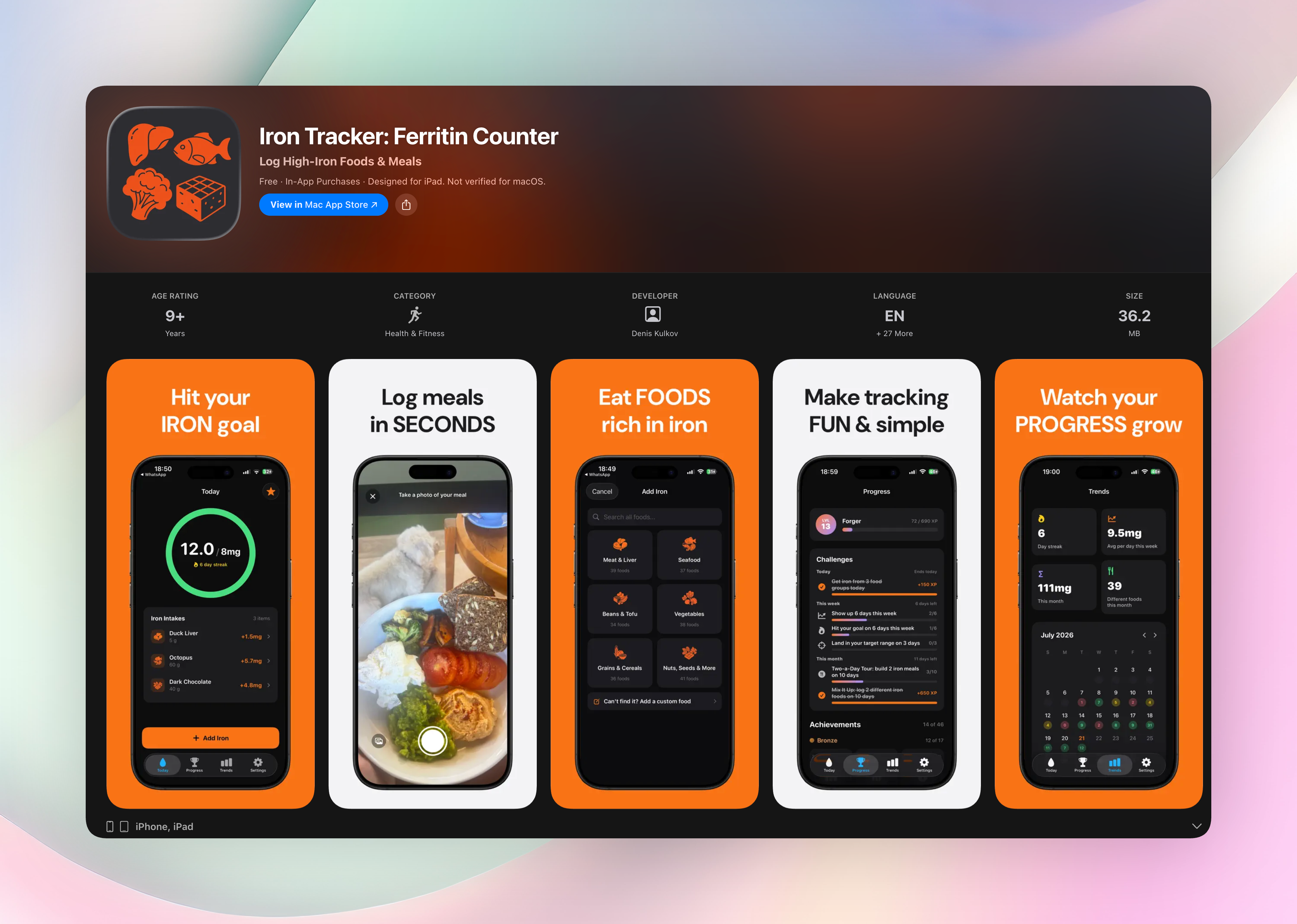
That gap is invisible unless you're recording what you ate next to what you paired it with. Iron Tracker, an iron intake tracking app for iPhone, is one way to keep that log so meals stay comparable week to week.
What helps iron absorption besides vitamin C
Other levers cover how to increase iron absorption without changing what you eat:
- Other organic acids — citric, malic, lactic — help modestly; fermented foods like sourdough and tempeh also degrade phytate.
- Soaking, sprouting, and leavening cut phytate before cooking starts.
- The "meat factor": even a small portion of muscle tissue lifts non-heme absorption across the whole meal.
Working the other direction: tea and coffee polyphenols cut non-heme absorption sharply if taken with the meal — move them an hour away. Calcium from dairy or supplements competes too, so keep pills away from your highest-iron meal. Phytate (whole grains, legumes, nuts) and oxalate (spinach, chard, beet greens) round out the inhibitor list.
Vitamin C partly overrides phytate, but the ratio has to climb as the phytate load does — it offsets inhibitors, it doesn't cancel them.
Vitamin C alongside iron supplements
Many iron supplements already include ascorbic acid, and the same single-meal logic applies: take it with the tablet, not later. The long-run picture is murkier — trials comparing iron alone against iron plus vitamin C over weeks haven't reliably shown the advantage absorption studies predict, likely because the body throttles uptake as stores refill. Dose and timing are a conversation for a clinician, especially for anyone with a condition that causes iron to accumulate.
FAQ
Does vitamin C help iron absorption?
Yes, for non-heme iron — the kind in plants, eggs, and fortified foods. It reduces ferric iron to the absorbable ferrous form and keeps it soluble through the duodenum. Single-meal studies commonly show two- to four-fold increases, biggest in meals loaded with phytate or polyphenols.
What vitamin helps iron absorption most?
Vitamin C, by a wide margin. Vitamin A and beta-carotene have been studied too, but the evidence is thinner. No vitamin meaningfully changes how much heme iron you absorb.
How much vitamin C should I eat with an iron-rich meal?
Roughly 12–13 mg per mg of non-heme iron on the plate — around 60–75 mg for a typical legume meal. Returns flatten above about 100 mg, and there's little argument for going past 200 mg.
Can I take vitamin C an hour after eating instead?
Not usefully. The reaction happens in the gut next to the iron, so vitamin C that arrives after the meal has moved through the duodenum never meets it. Same plate, same sitting.
Does orange juice count?
A cup delivers roughly 120 mg, more than enough. The catch is what else is on the table — tea, coffee, or a big calcium dose in the same meal pull hard the other way.
Free Iron tools
- Daily Iron RDA CalculatorEnter your age, sex, life stage and diet to see the published iron RDA, upper limit and vegetarian or vegan adjustment.
- Ferritin Change CalculatorCompare two ferritin test results with their dates and units to calculate the absolute change, percentage change and rate over time.
- Ferritin Unit ConverterEnter the ferritin value from your blood test and the unit your laboratory printed. The converter shows the same number in ng/mL, µg/L and pmol/L at once, with the standard adult reference ranges alongside it for comparison.
- Heme vs Non-Heme Iron ComparisonCompare heme vs non heme iron by entering the two amounts. See total iron and a clear percentage split for each form.
- Hemoglobin Unit ConverterHemoglobin lab test units are not the same everywhere. Enter the number on your report, pick the unit it is printed in, and convert hemoglobin g/dL to mmol/L or g/L — with the same value shown in all three units and the standard adult reference ranges beside it.
- Iron and Ferritin Level ChartPlot an iron or ferritin result against commonly used reference ranges. Choose the test, enter its value, and see whether it falls in the low, typical or high band.
- Iron-Rich Foods ChartCompare iron-rich foods by category, serving size and diet preference. See iron per serving, heme or non-heme type, and percent Daily Value.
- Iron-Rich Foods for Anemia ChartFilter a static food table by diet, serving size and iron type to compare iron per serving with preparation notes. This is a food reference, not a diagnosis.
- Iron Supplement Supply CalculatorEstimate how long a bottle lasts, its daily and 30-day cost, elemental iron per day and the date it runs out.
- MCH CalculatorEnter the hemoglobin value and red blood cell count from your blood test report. Get mean corpuscular hemoglobin (MCH) in picograms, plus where that number sits against the standard adult reference range of 27–33 pg. Nothing here is a diagnosis — lab results are interpreted by a clinician.
- Transferrin Saturation CalculatorEnter the serum iron and TIBC printed on your blood test and pick the unit they were reported in. Get transferrin saturation as a percentage, both values echoed in the other unit, and where the percentage falls against the published adult reference range.
- Vegetarian Iron Foods ChartCompare vegetarian iron sources by serving size, rank them by iron per portion, and see their contribution to your selected daily target.