Iron rich foods for pregnancy: what a 27 mg day looks like
Pregnancy raises the iron RDA to 27 mg a day, up from 18 mg for non-pregnant adult women. The iron rich foods for pregnancy that move it fastest are cooked shellfish, red meat, fortified cereal, beans, lentils, tofu, and spinach. Liver is the exception — high in iron, too high in preformed vitamin A.
Those are published general guidelines from the NIH Dietary Reference Intakes, not personal prescriptions. Supplements, lab work, and anything diagnostic belong with your prenatal provider.
Why iron needs during pregnancy jump to 27 mg
Blood volume expands over the nine months, red cell mass grows with it, and the fetus and placenta build iron stores of their own. Most of that transfer happens late — in the third trimester the baby stockpiles enough iron to carry it through roughly the first half-year of life, before solid food contributes much.
The gut compensates a little. Absorption efficiency climbs as pregnancy progresses, particularly in the second half, and the 27 mg figure already assumes that adaptation. It's also a flat number across all three trimesters even though real demand is back-loaded, so treat it as an average to aim at rather than a daily pass/fail. Baseline targets at other life stages are laid out in how much iron per day.
The upper limit for adults is 45 mg a day from food and supplements combined. Food alone almost never reaches it; a heavily fortified breakfast plus a supplement can.
Iron rich foods for pregnancy, by milligrams per serving
Values are rounded from USDA and NIH reference data. Fortified products vary by brand, so read the label instead of assuming.
| Food | Serving | Iron | Type |
|---|---|---|---|
| Clams, canned, drained | 3 oz | ~24 mg | Heme |
| Fortified breakfast cereal (100% DV) | 1 serving | 18 mg | Non-heme |
| Oysters, cooked | 3 oz | 8 mg | Heme |
| White beans, canned | 1 cup | 8 mg | Non-heme |
| Dark chocolate, 45–69% cacao | 1 oz | 3.4 mg | Non-heme |
| Lentils, boiled | ½ cup | 3 mg | Non-heme |
| Spinach, boiled | ½ cup | 3 mg | Non-heme |
| Firm tofu | ½ cup | 3 mg | Non-heme |
| Beef, braised bottom round | 3 oz | 2 mg | Mostly heme |
| Sardines, canned with bones | 3 oz | 2.5 mg | Mostly heme |
| Chickpeas, boiled | ½ cup | 2 mg | Non-heme |
| Potato, baked with skin | 1 medium | 2 mg | Non-heme |
| Cashews, oil roasted | 1 oz | 2 mg | Non-heme |
Two things stand out. Cooked shellfish and fortified cereal sit in a different league from everything else, and the rest of the list is a 2–3 mg grind. Without one of the top two, 27 mg means iron showing up at every meal.
Heme and non-heme iron aren't interchangeable at this target
Heme iron, from meat, poultry, and seafood, is absorbed at a higher and steadier rate than the non-heme iron in plants, eggs, and fortified grains. Non-heme absorption swings widely with the rest of the meal: vitamin C and a small amount of meat, poultry, or fish push it up, while phytates, polyphenols, and calcium pull it down. The mechanics are covered in heme vs non-heme iron.
That gap has a formal consequence. US guidelines put vegetarians' iron requirement at roughly 1.8 times the standard RDA to account for lower bioavailability, which lands a vegetarian pregnancy near 48 mg on paper — above the 45 mg upper limit. Nobody eats to that number. It's a signal that a plant-only iron plan in pregnancy is worth working through with a provider rather than alone.
What a 27 mg day looks like on a plate
With fortified cereal:
- Breakfast: one serving of cereal fortified to 100% DV (18 mg) with strawberries
- Lunch: lentil soup, ½ cup lentils (3 mg), slice of whole wheat bread (1 mg)
- Snack: 1 oz dark chocolate (3.4 mg)
- Dinner: 3 oz braised beef (2 mg), ½ cup spinach (3 mg)
Without it:
- Breakfast: two eggs (2 mg), two slices of whole wheat toast (2 mg)
- Lunch: 1 cup white beans (8 mg) with ½ cup stewed tomatoes (2 mg)
- Snack: 1 oz dark chocolate (3.4 mg), 1 oz cashews (2 mg)
- Dinner: 3 oz cooked oysters (8 mg), ½ cup spinach (3 mg), baked potato (2 mg)
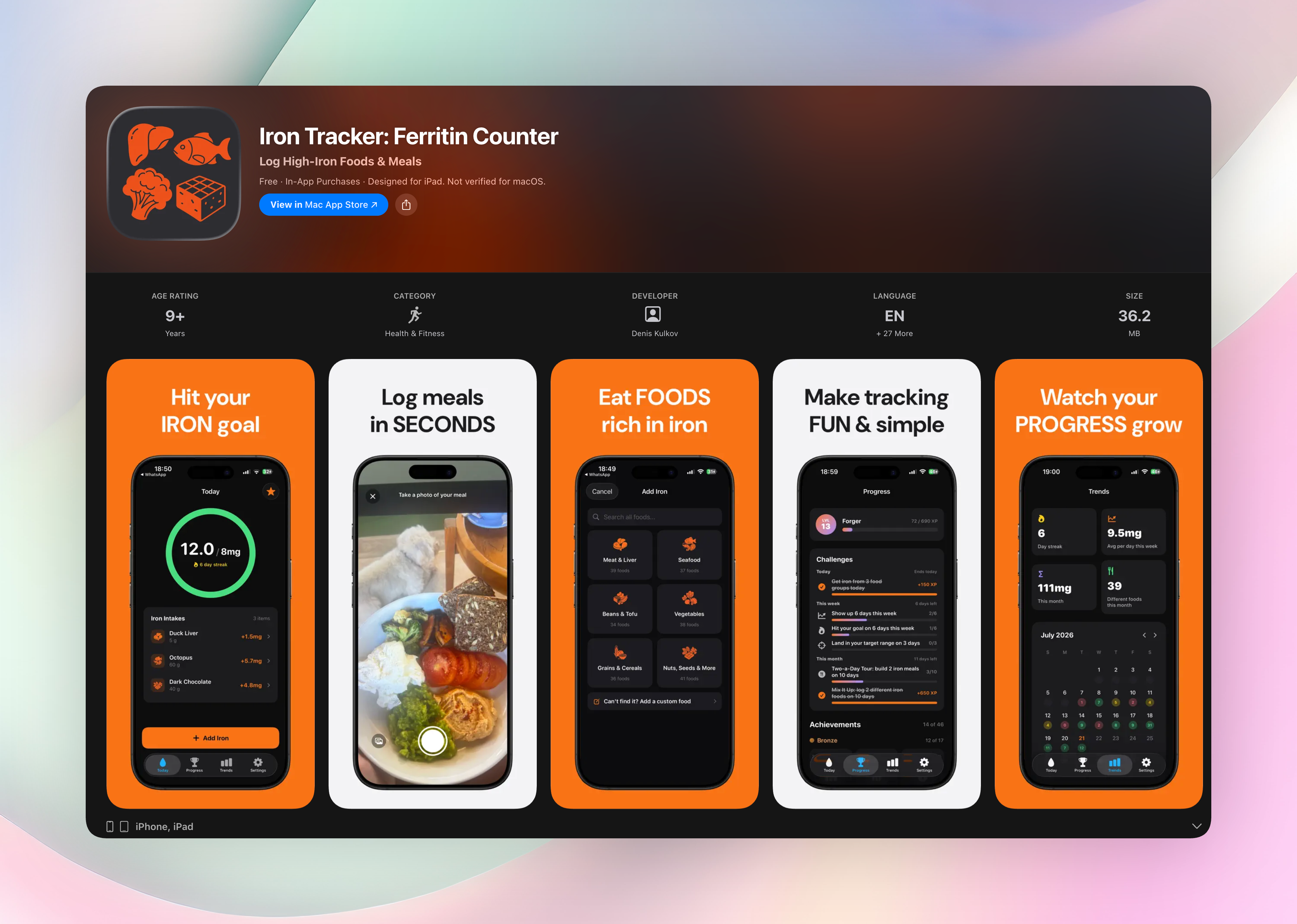
The second day is the honest one. It takes deliberate choices at all four eating occasions, and dropping one of the bigger items — the oysters, the beans — leaves you well short of 27 mg. That's the case for writing intake down for a week instead of estimating it; the number is high enough that eyeballing a day gets it wrong. Iron Tracker is an iron intake tracking app for iPhone, if you'd rather not keep that tally on paper.
High-iron foods to leave off the list
Liver and organ meats. Three ounces of pan-fried beef liver carries about 5 mg of iron and several thousand micrograms RAE of preformed vitamin A — well past the 3,000 mcg RAE daily upper limit for adults. Excess preformed vitamin A is linked to birth defects, which is why liver, pâté, and liverwurst come off the menu despite the iron. Beta-carotene from plants doesn't carry the same concern.
Raw shellfish. Clams and oysters top the iron table, but cooked through only. Raw versions are out for the usual foodborne-illness reasons, along with pâté and refrigerated meat spreads on listeria grounds.
High-mercury fish. Shark, swordfish, king mackerel, tilefish from the Gulf of Mexico, bigeye tuna, marlin, and orange roughy are the ones the FDA and EPA advise avoiding in pregnancy. Their guidance is 8 to 12 ounces a week of lower-mercury seafood — sardines, salmon, and canned light tuna all qualify, and all carry heme iron.
Timing: calcium is the loss most people inflict on themselves
Calcium is the one dietary factor known to inhibit both heme and non-heme iron. In pregnancy the collision is routine: a prenatal vitamin carrying both minerals, or a large glass of milk alongside the meal that holds most of the day's iron.
The fix is spacing, not subtraction. Calcium matters in pregnancy too, so keep dairy and any separate calcium supplement at the meals that aren't your iron anchor, and pair the iron-heavy meal with vitamin C instead — citrus, peppers, tomatoes, strawberries. Coffee and tea polyphenols behave the same way, and an hour's gap on either side of that meal removes most of the effect. The full list of what interferes is in what blocks iron absorption.
FAQ
How much iron during pregnancy is enough?
The RDA is 27 mg a day for pregnant women of any age, against 18 mg for non-pregnant women 19 to 50 and 9 mg during lactation. The ceiling from food and supplements combined is 45 mg a day.
Can you hit 27 mg from food alone?
It's possible — the sample days above get there — but it takes iron at every meal, or one heavily fortified product doing most of the work. Whether food alone is enough in your case depends on lab results your provider tracks, and that decision is theirs.
Are iron rich foods for pregnant women different from everyone else's?
The foods are the same; the amount and the exclusions differ. Liver, raw shellfish, and high-mercury fish come off the list, which removes several of the densest sources and makes the remaining ones count for more.
When do iron needs during pregnancy peak?
In the third trimester, when fetal iron transfer is heaviest and maternal absorption efficiency rises to meet it. The RDA stays flat at 27 mg across trimesters because it's set as an average intake, not a per-stage minimum.
Does the calcium in a prenatal vitamin block its iron?
It reduces absorption to some degree, and the effect is larger with big calcium doses than with the modest amounts most prenatals contain. If you take a separate calcium supplement, put it at a different time of day from your iron-heaviest meal.
Free Iron tools
- Daily Iron RDA CalculatorEnter your age, sex, life stage and diet to see the published iron RDA, upper limit and vegetarian or vegan adjustment.
- Ferritin Change CalculatorCompare two ferritin test results with their dates and units to calculate the absolute change, percentage change and rate over time.
- Ferritin Unit ConverterEnter the ferritin value from your blood test and the unit your laboratory printed. The converter shows the same number in ng/mL, µg/L and pmol/L at once, with the standard adult reference ranges alongside it for comparison.
- Heme vs Non-Heme Iron ComparisonCompare heme vs non heme iron by entering the two amounts. See total iron and a clear percentage split for each form.
- Hemoglobin Unit ConverterHemoglobin lab test units are not the same everywhere. Enter the number on your report, pick the unit it is printed in, and convert hemoglobin g/dL to mmol/L or g/L — with the same value shown in all three units and the standard adult reference ranges beside it.
- Iron and Ferritin Level ChartPlot an iron or ferritin result against commonly used reference ranges. Choose the test, enter its value, and see whether it falls in the low, typical or high band.
- Iron-Rich Foods ChartCompare iron-rich foods by category, serving size and diet preference. See iron per serving, heme or non-heme type, and percent Daily Value.
- Iron-Rich Foods for Anemia ChartFilter a static food table by diet, serving size and iron type to compare iron per serving with preparation notes. This is a food reference, not a diagnosis.
- Iron Supplement Supply CalculatorEstimate how long a bottle lasts, its daily and 30-day cost, elemental iron per day and the date it runs out.
- MCH CalculatorEnter the hemoglobin value and red blood cell count from your blood test report. Get mean corpuscular hemoglobin (MCH) in picograms, plus where that number sits against the standard adult reference range of 27–33 pg. Nothing here is a diagnosis — lab results are interpreted by a clinician.
- Transferrin Saturation CalculatorEnter the serum iron and TIBC printed on your blood test and pick the unit they were reported in. Get transferrin saturation as a percentage, both values echoed in the other unit, and where the percentage falls against the published adult reference range.
- Vegetarian Iron Foods ChartCompare vegetarian iron sources by serving size, rank them by iron per portion, and see their contribution to your selected daily target.