Iron rich meals: breakfast to dinner, with the mg attached
Iron rich meals follow one pattern: an iron anchor, a vitamin C source in the same sitting, and dairy and coffee pushed to another hour. Build plates that way and the daily number stops being guesswork. Every template below carries its milligrams.
How to build iron rich meals
Anchor the plate. Heme iron — beef, liver, oysters, clams, sardines — absorbs at roughly 15–35%. Non-heme iron from beans, lentils, tofu, seeds and fortified grains absorbs at 2–20%, depending on the rest of the plate. A heme anchor works alone; a non-heme anchor needs help. Start from the short list of iron rich foods that carry weight.
Add vitamin C in the same sitting, not later. The amounts are small: half a red bell pepper (≈75 mg), a medium orange (≈70 mg), a cup of strawberries (≈85 mg). Canned tomatoes, lemon juice and broccoli count too. More on the mechanism under vitamin C and iron absorption.
Move the dairy. In single-meal studies, 300–600 mg of calcium — a glass of milk, a yogurt, two slices of cheese — reduces absorption of both heme and non-heme iron. Whether that holds long term is less settled, but moving the latte to mid-morning costs nothing.
Give coffee and tea an hour of clearance. Polyphenols bind non-heme iron in the gut, and black tea is generally the stronger inhibitor (does coffee block iron absorption has the numbers). Phytate in grains and legumes does something similar; soaking, sprouting and fermenting cut it down.
Iron rich breakfasts
- Tofu scramble — ½ cup firm tofu (≈3 mg) with ½ cup wilted spinach (≈3 mg) and diced red pepper. ≈6 mg.
- Fortified cereal and berries — fortification runs from 10% to 100% of the 18 mg Daily Value, so read the panel. A 45% bowl is ≈8 mg. Strawberries on top, milk to a splash.
- Eggs on whole wheat — two eggs (≈2 mg), two slices (≈2 mg), an orange. ≈4 mg.
Iron rich lunches
- White bean and tomato salad — ½ cup canned white beans (≈4 mg), ½ cup stewed canned tomatoes (≈2 mg), lemon, olive oil. ≈6 mg.
- Lentil and quinoa bowl — ½ cup lentils (≈3 mg), ½ cup quinoa (≈1.4 mg), roasted red peppers. ≈5 mg.
- Sardines on toast — 3 oz canned sardines with bones (≈2 mg), two slices of whole wheat (≈2 mg), sliced tomato. ≈4 mg.
If you're working out how to get more iron in your diet without rebuilding the week, lunch is the cheapest swap: a bean bowl beats a chicken salad by about 5 mg.
Iron rich dinner recipes that carry the day
- Chickpea and spinach curry — 1 cup chickpeas (≈4 mg), ½ cup spinach (≈3 mg), canned tomatoes (≈2 mg), over enriched parboiled rice (≈1 mg). ≈10 mg.
- Beef chili — 3 oz ground beef (≈2 mg), ½ cup kidney beans (≈2 mg), ½ cup canned tomatoes (≈2 mg). ≈6 mg.
- Clams or oysters with pasta — 3 oz cooked oysters run ≈8 mg; 3 oz of canned clams are far higher, close to 24 mg. One clam night covers a day and a half.
- Liver and onions — 3 oz pan-fried beef liver is ≈5 mg. It's also very high in preformed vitamin A, which is why it's an occasional dinner.
Iron rich snacks that stack 3–5 mg
Most short days miss by a few milligrams, not by ten. That gap is snack-sized.
| Snack | Serving | Iron | Vitamin C partner |
|---|---|---|---|
| Pumpkin seed kernels | 1 oz | ≈2.3 mg | — |
| Dark chocolate, 45–69% | 1 oz | ≈1 mg | — |
| Edamame | 1 cup | ≈3.5 mg | — |
| Hummus with pepper strips | ½ cup | ≈2 mg | built in (≈75 mg) |
| Cashews, oil roasted | 1 oz | ≈2 mg | — |
| Dried apricots | ½ cup | ≈1.7 mg | — |
Two of these together usually cover a 3–5 mg gap — pair a lighter pick like dark chocolate or cashews with a heavier one like edamame or pumpkin seeds to be sure. Snacks are the easiest lever for anyone working out how to increase iron intake: a standing afternoon habit moves the weekly total more reliably than a bigger dinner.
An iron rich smoothie that actually absorbs
Frozen spinach beats raw by volume: ½ cup cooked is ≈3 mg where a cup of raw leaves is under 1 mg. Blend it with 2 tbsp pumpkin seeds (≈1.5 mg), ½ cup strawberries and orange juice — ≈5 mg with vitamin C already inside. Leave the yogurt out; spinach's oxalates hold iron tightly, and an iron rich smoothie built on greens and dairy is mostly a green drink.
A one-week iron rich diet plan
Seven days, no repeated dish, each landing at or above 18 mg — the NIH RDA for women 19–50 and the highest adult figure outside pregnancy.
- Tofu scramble · white bean and tomato salad · braised beef with potato and broccoli · pumpkin seeds — ≈19 mg
- Fortified flakes with an orange · turkey-hummus wrap with pepper strips · chicken, quinoa, broccoli · dried apricots — ≈19 mg
- Eggs on whole wheat · lentil and quinoa bowl · chickpea and spinach curry · 1 oz dark chocolate — ≈20 mg
- Overnight oats with raisins and kiwi · sardines on toast · beef chili heavy on the beans · edamame — ≈18 mg
- Spinach smoothie · falafel pita with tomato and tahini · oyster pasta in tomato sauce · cashews — ≈20 mg
- Fortified oats with strawberries · black bean and corn salad · liver and onions with potato and broccoli · roasted chickpeas — ≈18 mg
- Tempeh hash with peppers · split pea soup and a roll · mussels in tomato broth with bread · raisin and cashew trail mix — ≈19 mg
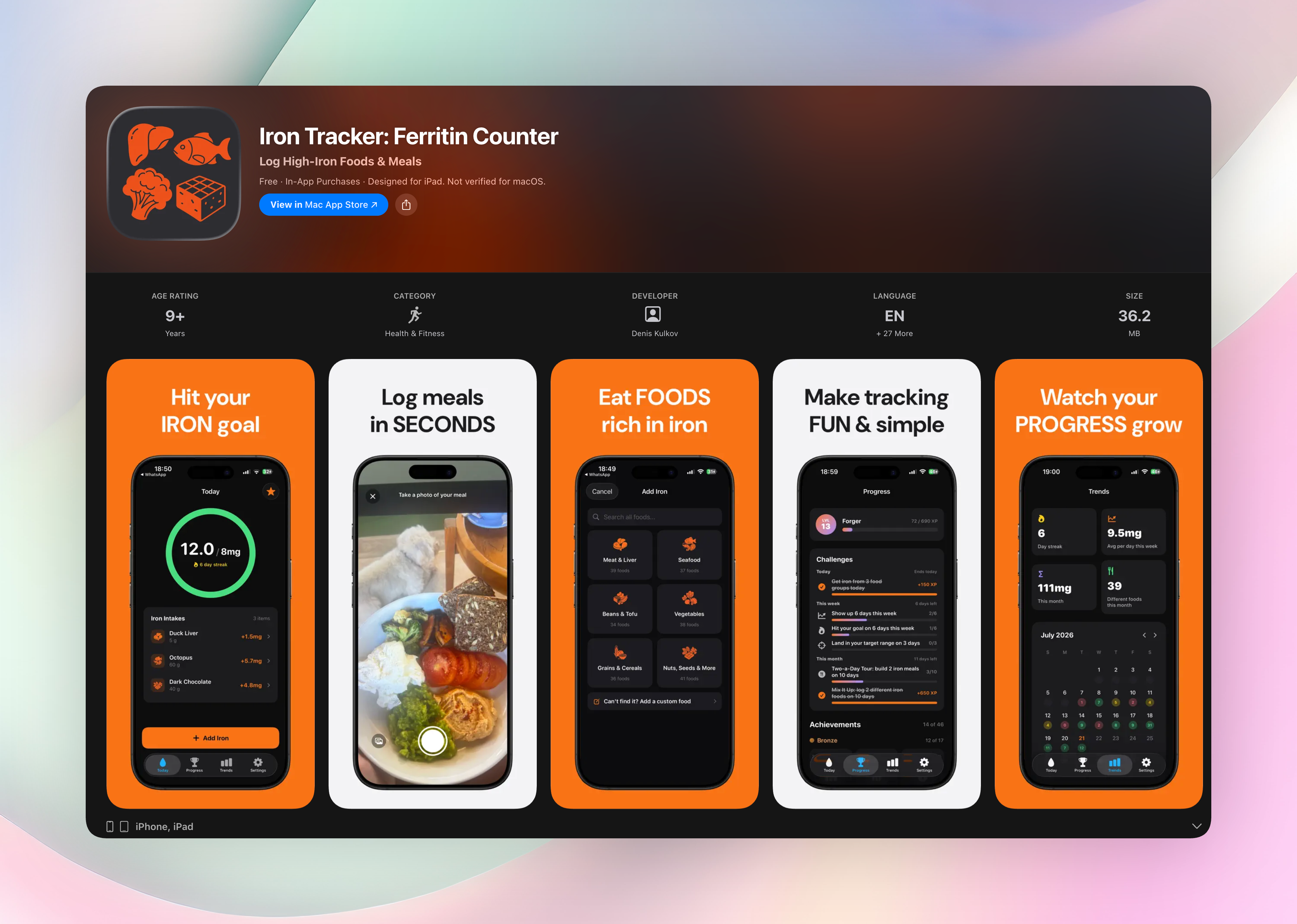
A rotation works only if you can see where the day stands by mid-afternoon, when the snack decision gets made. Iron Tracker is an iron intake tracking app for iPhone, and a running daily total is what turns a plan into a decision.
Clam and liver nights overshoot, which is fine — the published adult upper limit is 45 mg a day from food and supplements combined. Men 19 and older and women 51 and older sit at an 8 mg RDA, so 18 mg is generous for them. These are population guidelines, not personal targets.
FAQ
How many milligrams should iron rich meals add up to per day?
The NIH RDAs for adults are 8 mg for men 19 and older, 18 mg for women 19–50, 27 mg in pregnancy, and 8 mg for women 51 and older. These are published population guidelines, not a personal target — actual needs vary, and a clinician is the right call for anyone concerned about their own iron status.
Can you reach 18 mg on plants alone?
Yes, though the NIH suggests vegetarians aim for roughly 1.8 times the RDA — about 32 mg for women 19–50 — because non-heme iron absorbs less efficiently. Legumes at two meals, fortified grains, vitamin C every time, and soaked or fermented staples get you there.
Does cooking in a cast iron skillet count?
It does transfer iron, most with acidic, watery, long-simmered foods like tomato sauce. The amount swings with the pan's age and seasoning, so treat it as a bonus, not a line item.
Does the vitamin C have to be in the same meal?
Yes. The effect acts on the iron in the gut at that moment, so an orange two hours later doesn't do the same job as one eaten with the beans.
Free Iron tools
- Daily Iron RDA CalculatorEnter your age, sex, life stage and diet to see the published iron RDA, upper limit and vegetarian or vegan adjustment.
- Ferritin Change CalculatorCompare two ferritin test results with their dates and units to calculate the absolute change, percentage change and rate over time.
- Ferritin Unit ConverterEnter the ferritin value from your blood test and the unit your laboratory printed. The converter shows the same number in ng/mL, µg/L and pmol/L at once, with the standard adult reference ranges alongside it for comparison.
- Heme vs Non-Heme Iron ComparisonCompare heme vs non heme iron by entering the two amounts. See total iron and a clear percentage split for each form.
- Hemoglobin Unit ConverterHemoglobin lab test units are not the same everywhere. Enter the number on your report, pick the unit it is printed in, and convert hemoglobin g/dL to mmol/L or g/L — with the same value shown in all three units and the standard adult reference ranges beside it.
- Iron and Ferritin Level ChartPlot an iron or ferritin result against commonly used reference ranges. Choose the test, enter its value, and see whether it falls in the low, typical or high band.
- Iron-Rich Foods ChartCompare iron-rich foods by category, serving size and diet preference. See iron per serving, heme or non-heme type, and percent Daily Value.
- Iron-Rich Foods for Anemia ChartFilter a static food table by diet, serving size and iron type to compare iron per serving with preparation notes. This is a food reference, not a diagnosis.
- Iron Supplement Supply CalculatorEstimate how long a bottle lasts, its daily and 30-day cost, elemental iron per day and the date it runs out.
- MCH CalculatorEnter the hemoglobin value and red blood cell count from your blood test report. Get mean corpuscular hemoglobin (MCH) in picograms, plus where that number sits against the standard adult reference range of 27–33 pg. Nothing here is a diagnosis — lab results are interpreted by a clinician.
- Transferrin Saturation CalculatorEnter the serum iron and TIBC printed on your blood test and pick the unit they were reported in. Get transferrin saturation as a percentage, both values echoed in the other unit, and where the percentage falls against the published adult reference range.
- Vegetarian Iron Foods ChartCompare vegetarian iron sources by serving size, rank them by iron per portion, and see their contribution to your selected daily target.