
Meat high in iron: every source ranked by milligrams per serving
Meat high in iron falls into three tiers: organ meat, bivalve shellfish, and — some distance behind — red muscle meat. Liver, clams, and oysters run roughly 5 to 24 mg per 3-ounce serving. Beef and lamb sit near 2–3 mg, while pork, chicken, and most fish come in under 1.5 mg.
Why serving size decides the ranking
Most nutrient tables publish per 100 grams, and many publish raw weights. Both choices distort the comparison. Meat loses roughly 20–30% of its weight as water during cooking, so 100 g of raw sirloin lands closer to 70–75 g on the plate, with its iron concentrated into that smaller mass.
Everything below is per 3 ounces (85 g) of cooked meat — the standard US reference serving, about the size of a deck of cards. Real portions rarely match it. A restaurant steak runs 8–12 oz, a cooked chicken breast is usually 5–7 oz, and a can of clams drains to about 6 oz. Multiply accordingly. The point of a per-serving figure is that you can add it up.
Meat high in iron, ranked by milligrams per serving
| Meat or seafood (3 oz cooked) | Iron (mg) | % of 18 mg |
|---|---|---|
| Clams, canned, drained | ~23 | 128% |
| Chicken liver, pan-fried | ~10 | 56% |
| Oysters, cooked | ~8 | 44% |
| Mussels, steamed | ~5.7 | 32% |
| Beef liver, pan-fried | ~5 | 28% |
| Beef kidney, simmered | ~4 | 22% |
| Venison, roasted | ~3.4 | 19% |
| Beef chuck, braised | ~3.1 | 17% |
| Bison, roasted | ~2.5 | 14% |
| Lamb shoulder, braised | ~2.3 | 13% |
| Duck, roasted | ~2.3 | 13% |
| Ground beef, 85% lean | ~2.2 | 12% |
| Sardines, canned with bones | ~2.1 | 12% |
| Turkey, dark meat | ~2.0 | 11% |
| Beef sirloin, grilled | ~1.6 | 9% |
| Tuna, canned light | ~1.3 | 7% |
| Chicken thigh, roasted | ~1.1 | 6% |
| Pork loin chop | ~0.9 | 5% |
| Chicken breast, roasted | ~0.9 | 5% |
| Turkey breast, roasted | ~0.7 | 4% |
| Salmon, cooked | ~0.5 | 3% |
| Shrimp, cooked | ~0.4 | 2% |
Percentages are against 18 mg, the NIH RDA for women aged 19–50. For adult men and women 51+, the RDA is 8 mg, so every figure represents more than double the share shown.
Organ meat and shellfish are a tier of their own
The distance between the top of that table and its middle isn't a rounding difference — it's roughly an order of magnitude. Iron in liver is high for the obvious reason: the liver is the body's iron warehouse, and ferritin-bound stores come with the tissue. Bivalves filter-feed and concentrate minerals from the water they sit in, which is why clams, mussels, and oysters outrank every land animal.
Two honest caveats. Liver is also a concentrated source of preformed vitamin A — a 3-ounce serving of beef liver exceeds the tolerable upper intake level of 3,000 mcg RAE per day set for adults, and chicken liver, while roughly half as high, still lands above it. That's published general guidance, not a personal prescription, but it's the reason liver tends to appear in weekly rather than daily eating patterns. Second, canned clam values swing with brand and drained weight; a drained 6-ounce can is a realistic portion, and the label's own numbers beat any generic table.
Ground beef, steak, and liver are not interchangeable
Treating "red meat" as one number is the most common error here. Braised chuck carries about twice the iron of a grilled sirloin at the same weight, and liver carries several times either.
Iron tracks myoglobin, and myoglobin tracks how hard a muscle worked. Shoulder, shank, and chuck are load-bearing muscles — darker, denser in myoglobin, and higher in iron per ounce. Loin cuts like sirloin, strip, and tenderloin do less work and run paler and lower. Two other levers matter: fat dilutes, so a 73% lean grind has less iron per ounce than a 93% grind, and braising drives off water, concentrating what remains.
Lamb behaves the same way, with shoulder and shank above loin, landing in the 2–3 mg range. Venison and bison generally edge out beef at comparable cuts, since game muscle is leaner and darker.
Pork, poultry, and fish are modest heme sources
White meat gets filed alongside red meat as "iron-rich protein," and it doesn't earn the label. Iron in chicken is about 0.9 mg per 3 oz for breast and about 1.1 mg for thigh — dark meat wins, for the myoglobin reason above, but neither is a meaningful contributor. Turkey splits the same way: dark meat near 2 mg, breast near 0.7 mg. Pork is pale muscle whatever the marketing says, and a loin chop sits under 1 mg.
Iron in seafood splits harder than any other category. Bivalves top the entire list; finfish sit near the bottom, with salmon around 0.5 mg and cod around 0.4 mg per 3 oz. Canned light tuna does better at roughly 1.3 mg, and sardines canned with their bones reach about 2.1 mg. Shrimp is shellfish but not a bivalve, and it tracks the finfish at roughly 0.4 mg.
Two dinners, same weight, six times the iron
Put 6 ounces of animal protein on each of two plates. Plate one is a grilled chicken breast: about 1.8 mg. Plate two is steamed mussels: about 11 mg. Same weight, same slot on the plate, six times the iron.
The same trick works within a single species. Six ounces of braised chuck delivers around 6.2 mg; six ounces of grilled sirloin, around 3.2 mg. Both are beef, both are dinner, and one is nearly double the other.
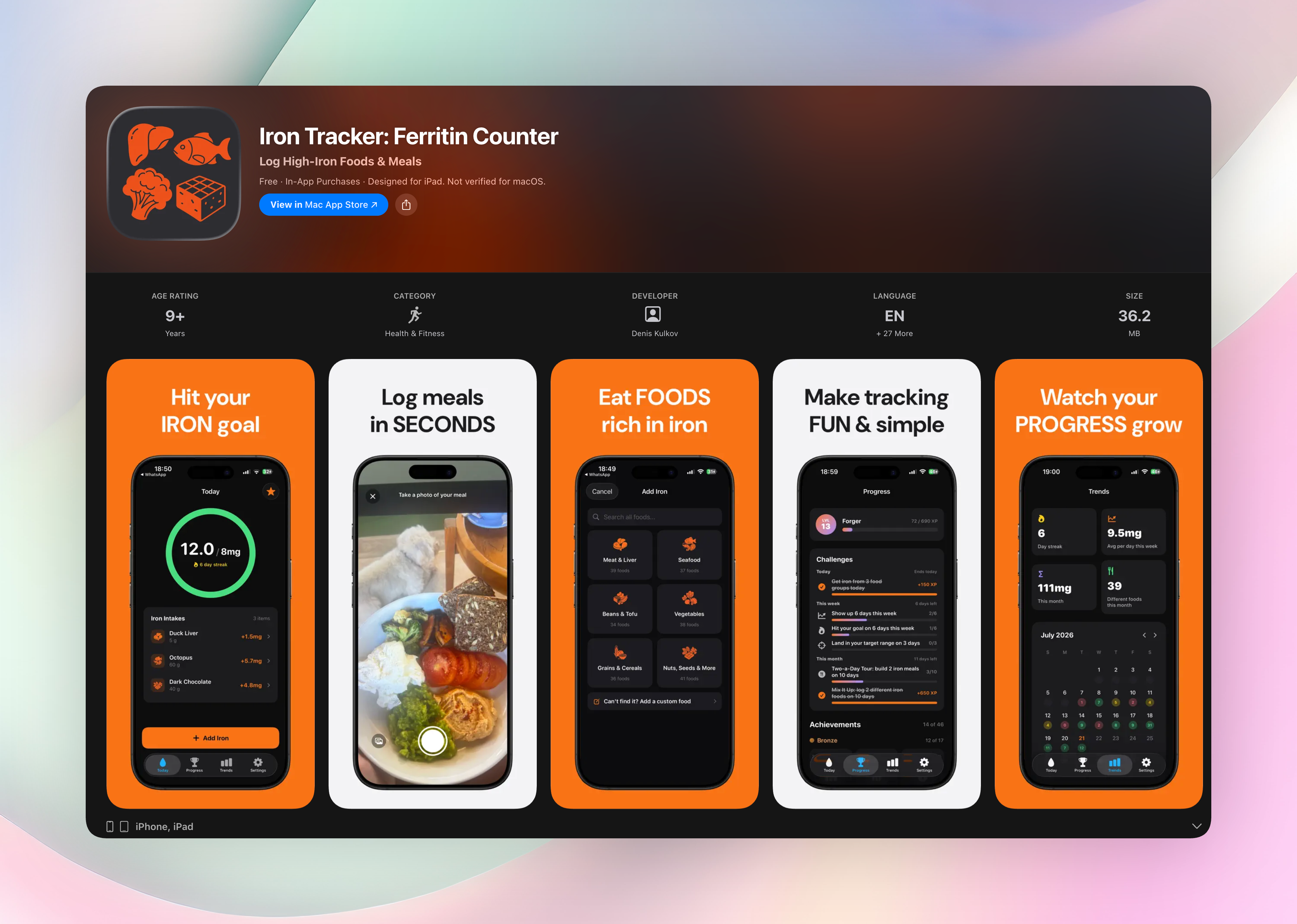
That's the point at which a generic 3-ounce reference stops being useful, since almost nobody eats 3 ounces. If you'd rather have your actual portions counted than convert reference servings by hand, Iron Tracker is an iron intake tracking app for iPhone.
Heme iron doesn't behave like the iron in plants
Roughly 40% of the iron in meat, poultry, and fish is heme — held inside the porphyrin ring of hemoglobin and myoglobin. The remainder is non-heme, chemically the same as the iron in beans or spinach. Heme iron is absorbed at a higher and far steadier rate, commonly cited at about 15–35% against 2–20% for non-heme, and it's largely indifferent to the tea, coffee, calcium, and phytates that blunt non-heme absorption.
Two things follow. A 2 mg serving of steak and a 2 mg serving of lentils are not the same 2 mg delivered. And meat raises absorption of the non-heme iron eaten with it — the so-called meat factor — so a side of spinach fares better next to beef than next to rice. Set against published targets, how much iron per day a person is aiming for shifts with age, sex, pregnancy, and whether the diet includes meat at all.
FAQ
Which meat has the most iron?
Canned clams, at roughly 23 mg per drained 3-ounce serving, beat everything else by a wide margin. Among land animals, chicken liver leads at about 10 mg, with beef liver around 5 mg. Among ordinary muscle cuts, braised chuck and venison top out near 3 mg.
How much iron in steak?
A 3-ounce grilled sirloin carries about 1.6 mg. A 12-ounce restaurant steak lands somewhere near 6–7 mg depending on the cut. Worked cuts such as chuck and shank run higher than loin cuts of the same weight.
Is chicken a good source of iron?
Only modestly. Roasted breast is about 0.9 mg per 3 oz and thigh about 1.1 mg — useful as part of a day's total, not as the main source. Chicken liver is the exception at roughly 10 mg per 3 oz.
Does cooking change the iron in meat?
Iron is a mineral and heat doesn't destroy it, but water loss concentrates it per gram, so cooked weights read higher than raw. Some iron leaves in drippings and pan juices. Cooking in bare cast iron adds a small amount, more so with acidic, long-simmered dishes.
Can you get too much iron from meat?
Published guidance sets the tolerable upper intake level at 45 mg a day for adults, and that ceiling is aimed mainly at supplements. Reaching it from food alone would take several liver or clam servings in a single day. Conditions affecting how the body stores iron are a medical matter rather than a dietary calculation.
Free Iron tools
- Daily Iron RDA CalculatorEnter your age, sex, life stage and diet to see the published iron RDA, upper limit and vegetarian or vegan adjustment.
- Ferritin Change CalculatorCompare two ferritin test results with their dates and units to calculate the absolute change, percentage change and rate over time.
- Ferritin Unit ConverterEnter the ferritin value from your blood test and the unit your laboratory printed. The converter shows the same number in ng/mL, µg/L and pmol/L at once, with the standard adult reference ranges alongside it for comparison.
- Heme vs Non-Heme Iron ComparisonCompare heme vs non heme iron by entering the two amounts. See total iron and a clear percentage split for each form.
- Hemoglobin Unit ConverterHemoglobin lab test units are not the same everywhere. Enter the number on your report, pick the unit it is printed in, and convert hemoglobin g/dL to mmol/L or g/L — with the same value shown in all three units and the standard adult reference ranges beside it.
- Iron and Ferritin Level ChartPlot an iron or ferritin result against commonly used reference ranges. Choose the test, enter its value, and see whether it falls in the low, typical or high band.
- Iron-Rich Foods ChartCompare iron-rich foods by category, serving size and diet preference. See iron per serving, heme or non-heme type, and percent Daily Value.
- Iron-Rich Foods for Anemia ChartFilter a static food table by diet, serving size and iron type to compare iron per serving with preparation notes. This is a food reference, not a diagnosis.
- Iron Supplement Supply CalculatorEstimate how long a bottle lasts, its daily and 30-day cost, elemental iron per day and the date it runs out.
- MCH CalculatorEnter the hemoglobin value and red blood cell count from your blood test report. Get mean corpuscular hemoglobin (MCH) in picograms, plus where that number sits against the standard adult reference range of 27–33 pg. Nothing here is a diagnosis — lab results are interpreted by a clinician.
- Transferrin Saturation CalculatorEnter the serum iron and TIBC printed on your blood test and pick the unit they were reported in. Get transferrin saturation as a percentage, both values echoed in the other unit, and where the percentage falls against the published adult reference range.
- Vegetarian Iron Foods ChartCompare vegetarian iron sources by serving size, rank them by iron per portion, and see their contribution to your selected daily target.