Vegetables high in iron, and the fruit worth counting
The vegetables high in iron are almost all legumes and dark leafy greens — cooked lentils, canned white beans, and cooked spinach each land between 6 and 8 mg per cup. Most fresh fruit carries under half a milligram, and drying it only concentrates a small starting number.
Vegetables high in iron, measured per cooked cup
Raw weights flatter produce. A cup of raw spinach is 30 grams and about 0.8 mg of iron; a cup of cooked spinach is 180 grams and about 6.4 mg. Every figure below is cooked, canned, or baked as marked — the way you'd actually eat it.
| Vegetable | Serving | Iron (mg) | Main limiter |
|---|---|---|---|
| Soybeans | 1 cup | ~8.8 | phytates |
| White beans, canned | 1 cup | ~7.8 | phytates |
| Tomato paste | 1 cup | ~7.8 | serving size |
| Lentils | 1 cup | ~6.6 | phytates |
| Spinach | 1 cup | ~6.4 | oxalates |
| Chickpeas | 1 cup | ~4.7 | phytates |
| Swiss chard | 1 cup | ~4.0 | oxalates |
| Potato, baked with skin | 1 medium | ~1.9 | — |
| Brussels sprouts | 1 cup | ~1.9 | — |
| Broccoli | 1 cup | ~1.0 | — |
| Kale | 1 cup | ~1.0 | — |
Tomato paste needs a footnote: a cup is 262 grams, and a 6-ounce can comes to about 5 mg — a stirred-in tablespoon is closer to 0.5 mg. It's on the list because a sauce built on half a can is a contributor, not because anyone eats it by the cup.
Oxalates and phytates: why the top of the ranking underperforms
Produce iron is entirely non-heme iron, the form your body treats differently from the iron in meat — absorbed at a single-digit percentage of what's on the plate in a bad meal, several times that in a good one. Two compounds explain most of the gap.
Oxalates bind iron in the gut and concentrate in exactly the greens that top the list — spinach and Swiss chard both. The milligram counts are accurate; the fraction you keep is low.
Phytates, in the seed coat of every legume and whole grain, are the strongest known dietary inhibitor of non-heme absorption. Soaking, sprouting, and fermenting all cut phytate content; canned beans have had a long hot cook, which helps.
That's the honest read on iron rich vegetables: the ranking tells you what's in the food, not what ends up in you.
Iron in broccoli, kale, and the greens that punch above their number
Iron in broccoli is modest — about 1 mg per cooked cup, 0.7 mg raw. Kale runs similar. Both sit near the bottom of the milligram ranking and the top of the useful one: low in oxalates, so nothing binds the iron on the way down, and a cooked cup of broccoli carries around 100 mg of vitamin C in the same mouthful.
Bok choy and cabbage behave the same way. A cooked cup of Brussels sprouts is about 1.9 mg of iron alongside roughly 95 mg of vitamin C.
Iron rich fruits are a short list
Per realistic serving:
- Prune juice, 1 cup — about 3 mg
- Mulberries, 1 cup — about 2.6 mg
- Dried apricots, ½ cup — about 1.7 mg
- Raisins, ½ cup packed — about 1.5 mg
- Dried figs, ½ cup — about 1.5 mg
- Avocado, 1 whole — about 1.1 mg
- Blackberries or raspberries, 1 cup — about 0.9 mg
- Strawberries, 1 cup — about 0.6 mg
- Banana, 1 medium — about 0.3 mg
- Apple, 1 medium — about 0.2 mg
- Orange, 1 medium — about 0.1 mg
The pattern is blunt: nothing fresh and common clears 1 mg. The fruits worth planning around — prune juice, dried apricots, raisins — are all pressed or dried.
Iron in raisins and iron in dates
Raisins run about 1.9 mg of iron per 100 grams versus 0.36 mg for fresh grapes — drying removes water, not iron. A 1.5-ounce snack box comes to roughly 0.8 mg.
Dates are lower than reputation suggests: Medjool dates run about 0.9 mg per 100 grams, and at about 24 grams each, three total roughly 0.7 mg — a tenth of what a cup of lentils gives. Good sugar source, weak iron one.
Pair each entry with vitamin C from the same aisle
Vitamin C converts iron to a form the gut absorbs more readily, freeing some from compounds that would otherwise bind it. About 50 mg in the same meal is enough to shift the number, and vitamin C and iron absorption scale together.
Partners are already in the produce section:
- Red bell pepper, 1 cup chopped — about 190 mg vitamin C
- Broccoli, 1 cooked cup — about 100 mg
- Brussels sprouts, 1 cooked cup — about 95 mg
- Strawberries, 1 cup — about 90 mg
- Orange, 1 medium — about 70 mg
So: lentils with roasted peppers, chickpeas with lemon, spinach with strawberries rather than alone. The raw or acidic component goes in near the end of cooking, since vitamin C degrades with heat. Long-simmered acidic dishes like tomato sauce also pick up measurable iron from a cast-iron pan.
How much of your day this actually covers
The NIH's published general guidance sets the RDA at 8 mg a day for men and women 51+, 18 mg for women 19–50, and 27 mg during pregnancy; people eating no meat need roughly 1.8 times those amounts, since non-heme iron absorbs less efficiently.
Run a plant-heavy day against that: a cup of lentils (6.6), a cup of cooked spinach (6.4), a baked potato with skin (1.9), and a half cup of raisins (1.5) total 16.4 mg on paper — most of an 18 mg target, though weaker absorbed, since three of four are phytate- or oxalate-limited. That's the argument for the vitamin C pairing, not a footnote to it.
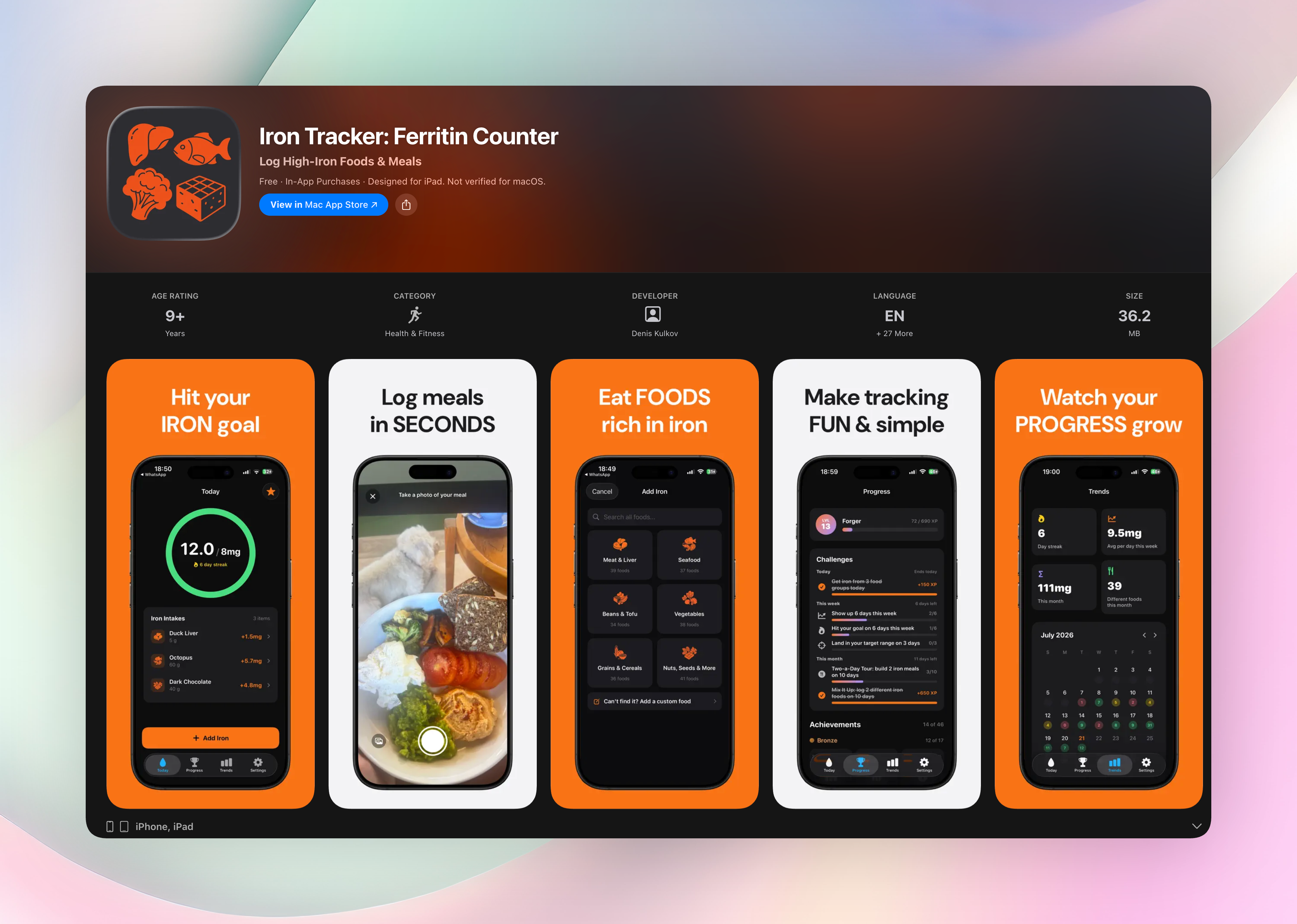
The arithmetic is tedious, since produce iron arrives in cups and half cups, not tidy portions. Iron Tracker, an iron intake tracking app for iPhone, keeps the running total, making it easier to see where a day like that sits against the daily iron target.
FAQ
Which vegetable has the most iron?
Cooked spinach leads the leafy greens at about 6.4 mg per cup; soybeans (about 8.8 mg) and canned white beans (about 7.8 mg) beat it. All three are limited by oxalates or phytates, so the absorbed share is well under the listed figure.
Is broccoli a good source of iron?
Disproportionately, yes. A cooked cup holds only about 1 mg, but broccoli is low in oxalates and carries roughly 100 mg of vitamin C in the same serving, so more of that milligram survives digestion than a bigger number from spinach would.
Do raisins have more iron than fresh grapes?
Per gram, about five times more — roughly 1.9 mg per 100 grams versus 0.36 mg for grapes, from water removal, not iron addition. Per serving it stays modest: about 1.5 mg for a packed half cup.
Are there fruits high in iron that beat vegetables?
Prune juice, at about 3 mg a cup, is the only common one reaching the middle of the vegetable ranking. Nothing fresh comes near lentils, white beans, or cooked spinach.
Does cooking change how much iron a vegetable has?
Cooking doesn't create iron; it shrinks the food — a cup of cooked spinach packs about six times the leaf mass of a raw cup, which is why the cooked figure looks larger. Simmering acidic dishes in cast iron does add iron to the food.
Free Iron tools
- Daily Iron RDA CalculatorEnter your age, sex, life stage and diet to see the published iron RDA, upper limit and vegetarian or vegan adjustment.
- Ferritin Change CalculatorCompare two ferritin test results with their dates and units to calculate the absolute change, percentage change and rate over time.
- Ferritin Unit ConverterEnter the ferritin value from your blood test and the unit your laboratory printed. The converter shows the same number in ng/mL, µg/L and pmol/L at once, with the standard adult reference ranges alongside it for comparison.
- Heme vs Non-Heme Iron ComparisonCompare heme vs non heme iron by entering the two amounts. See total iron and a clear percentage split for each form.
- Hemoglobin Unit ConverterHemoglobin lab test units are not the same everywhere. Enter the number on your report, pick the unit it is printed in, and convert hemoglobin g/dL to mmol/L or g/L — with the same value shown in all three units and the standard adult reference ranges beside it.
- Iron and Ferritin Level ChartPlot an iron or ferritin result against commonly used reference ranges. Choose the test, enter its value, and see whether it falls in the low, typical or high band.
- Iron-Rich Foods ChartCompare iron-rich foods by category, serving size and diet preference. See iron per serving, heme or non-heme type, and percent Daily Value.
- Iron-Rich Foods for Anemia ChartFilter a static food table by diet, serving size and iron type to compare iron per serving with preparation notes. This is a food reference, not a diagnosis.
- Iron Supplement Supply CalculatorEstimate how long a bottle lasts, its daily and 30-day cost, elemental iron per day and the date it runs out.
- MCH CalculatorEnter the hemoglobin value and red blood cell count from your blood test report. Get mean corpuscular hemoglobin (MCH) in picograms, plus where that number sits against the standard adult reference range of 27–33 pg. Nothing here is a diagnosis — lab results are interpreted by a clinician.
- Transferrin Saturation CalculatorEnter the serum iron and TIBC printed on your blood test and pick the unit they were reported in. Get transferrin saturation as a percentage, both values echoed in the other unit, and where the percentage falls against the published adult reference range.
- Vegetarian Iron Foods ChartCompare vegetarian iron sources by serving size, rank them by iron per portion, and see their contribution to your selected daily target.