Iron rich foods for period days: a cycle-aware eating guide
The best iron rich foods for period days are heme sources — beef, liver, oysters, sardines — alongside lentils, tofu, white beans, and fortified cereal. Eat them with vitamin C, and keep coffee, tea, and dairy on other meals. Menstruation is the whole reason the adult female RDA sits at 18 mg.
Why menstruation more than doubles the iron target
The published U.S. RDA for iron is 8 mg a day for men 19 and older and 18 mg a day for women 19–50. After menopause it drops back to 8 mg. Girls 14–18 sit at 15 mg, pregnancy at 27 mg. The only thing separating an 8 mg target from an 18 mg one is a monthly blood loss.
The arithmetic is small and relentless. A typical cycle sheds around 30–40 mL of blood, and blood carries roughly 0.5 mg of iron per milliliter. That's about 15–20 mg of iron leaving the body every cycle, or half a milligram a day averaged across the month. Heavier bleeding costs proportionally more; clinicians have long used 80 mL per cycle as a threshold for heavy menstrual bleeding.
The other half of the gap is absorption. The RDA assumes roughly 18% of dietary iron gets absorbed from a mixed diet that includes meat. Eighteen milligrams on the plate is not 18 mg in the blood. For people who eat no meat at all, the published guideline is 1.8 times the RDA — around 32 mg a day — because a plant-only diet absorbs closer to 10%.
Iron rich foods for women don't change with age. Only the target does: 18 mg through the menstruating years, 8 mg after. These are population reference values, not personal prescriptions.
Iron rich foods for period days, by milligrams per serving
| Food | Serving | Iron (mg) | Type |
|---|---|---|---|
| Fortified breakfast cereal (100% DV) | 1 serving | 18 | Non-heme |
| Oysters, cooked | 3 oz | 8 | Heme |
| White beans, canned | 1 cup | 8 | Non-heme |
| Dark chocolate, 45–69% cacao | 3 oz | 7 | Non-heme |
| Beef liver, pan-fried | 3 oz | 5 | Heme |
| Lentils, boiled | ½ cup | 3 | Non-heme |
| Spinach, boiled | ½ cup | 3 | Non-heme |
| Tofu, firm | ½ cup | 3 | Non-heme |
| Beef, braised bottom round | 3 oz | 2 | Heme |
| Sardines, canned with bone | 3 oz | 2 | Heme |
| Chickpeas, boiled | ½ cup | 2 | Non-heme |
| Pumpkin seeds, roasted | 1 oz | 2 | Non-heme |
| Egg, hard-boiled | 1 large | 1 | Non-heme |
Two things stand out. The largest numbers are non-heme — fortified cereal, white beans, dark chocolate — and those are the milligrams least likely to be absorbed. And the servings are real: 3 oz of dark chocolate is about 85 g.
Heme and non-heme iron behave differently
Heme iron comes from the hemoglobin and myoglobin in meat, poultry, and seafood. It has its own uptake route, absorbs at a much higher rate, and mostly ignores whatever else is on the plate. Non-heme iron — every plant source, plus the iron added to fortified foods — travels a pathway that's easy to help and easy to block, so its absorption swings from low single digits to around 20% depending on the meal around it. The full comparison lives in heme vs non-heme iron.
Even for daily meat eaters, most dietary iron is non-heme, and that's the fraction worth engineering. A modest amount of meat, fish, or poultry also raises absorption of the non-heme iron sitting beside it, so a few ounces of beef in a lentil stew improves the lentils.
Pair iron with vitamin C on the heaviest days
Vitamin C is the strongest food-level lever on non-heme absorption. It holds iron in the more soluble ferrous form through the small intestine and keeps binders from locking it up. Roughly 50–100 mg does the work, and it has to be in the same meal — not just the same day. The mechanism is covered in vitamin C and iron absorption.
Approximate vitamin C per serving:
- Raw red bell pepper, ½ cup — about 95 mg
- Orange, 1 medium — about 70 mg
- Kiwifruit, 1 medium — about 64 mg
- Cooked broccoli, ½ cup — about 51 mg
- Strawberries, ½ cup — about 49 mg
Which turns into meals: lentil soup finished with tomato and lemon, tofu stir-fried with broccoli and red pepper, fortified oatmeal under sliced strawberries, bean chili built on canned tomatoes.
Move coffee, tea, and dairy off those meals
Three common things suppress non-heme absorption, and all three can be rescheduled rather than given up.
Coffee and tea. Polyphenols and tannins bind non-heme iron in the gut, black tea most strongly, coffee close behind. Drinking either with the meal rather than an hour clear of it is where the loss happens. More detail in coffee, tea, and iron absorption.
Calcium. Dairy and calcium supplements are the one interference that reaches heme iron as well as non-heme. Yogurt makes a good snack and a poor side dish next to steak or a bowl of lentils.
Phytates. Whole grains, legumes, nuts, and seeds carry iron and phytate together, and phytate binds the iron. Soaking, sprouting, and long fermentation — sourdough, tempeh — cut phytate down, and vitamin C in the same meal offsets much of what remains.
Supplements are a separate conversation, and one for a clinician. This is a food guide.
A cycle-aware eating pattern
The daily guideline doesn't move across the cycle — 18 mg on day 2, 18 mg on day 22. What changes is how much effort the absorption side is worth.
Days 1–3, when flow is usually heaviest. Put a heme source in one meal if you eat animal foods. Give the other meals a deliberate vitamin C partner. Push coffee to mid-morning so it isn't sharing a table with fortified cereal.
The rest of the cycle. Build a base instead of a rescue: some iron in most meals, legumes several times a week, vitamin C on autopilot. Steady intake across four weeks beats one enormous liver dinner, because uptake is capped per meal — a 30 mg day doesn't bank against five 6 mg days.
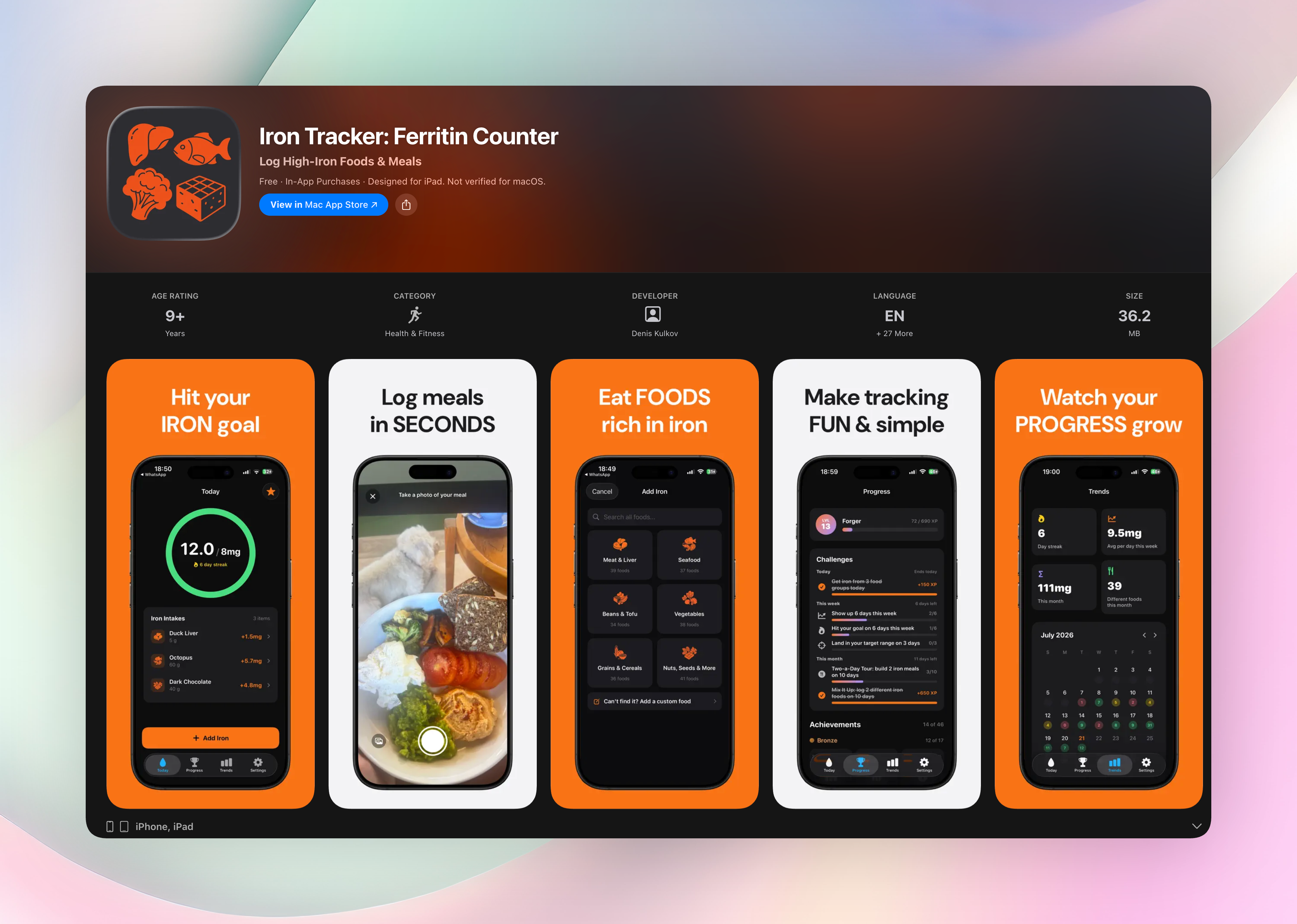
That pattern is hard to see from memory. Daily totals swing by a factor of three, so the view that means anything is the monthly average and where the low weeks land, which takes a log spanning weeks. Iron Tracker, an iron intake tracking app for iPhone, is one way to keep that running record.
FAQ
How much iron does a woman need each day?
The published RDA is 18 mg a day for women 19–50, 8 mg from 51 on, 15 mg for girls 14–18, and 27 mg during pregnancy. Those are population guidelines, not individual targets. The tolerable upper intake level for adults is 45 mg a day from food and supplements combined.
What are the best iron rich foods for period days without meat?
Fortified breakfast cereal, white beans, lentils, tofu, chickpeas, pumpkin seeds, and cooked spinach carry the most per serving. Because plant iron absorbs less efficiently, the guideline for people eating no meat is 1.8 times the standard RDA, and pairing those foods with vitamin C matters more than it does for meat eaters.
Does coffee on your period really block iron?
It blocks a meaningful share of the non-heme iron in the meal it's drunk with, not iron eaten earlier in the day. The fix is spacing — keep coffee and tea roughly an hour clear of iron-heavy meals. Heme iron from meat and seafood is largely unaffected either way.
Are iron rich foods for females different from the ones men should eat?
The foods are identical. Only the target differs, 18 mg against 8 mg for adults under 51, so iron rich foods for women usually need more attention to absorption helpers rather than a separate shopping list.
Does cooking in a cast iron pan add iron?
Some, and more with acidic, wet, long-simmered dishes like tomato sauce. It's non-heme iron, and the amount varies with the pan's age and seasoning, so treat it as a small bonus rather than a source worth counting on.
Free Iron tools
- Daily Iron RDA CalculatorEnter your age, sex, life stage and diet to see the published iron RDA, upper limit and vegetarian or vegan adjustment.
- Ferritin Change CalculatorCompare two ferritin test results with their dates and units to calculate the absolute change, percentage change and rate over time.
- Ferritin Unit ConverterEnter the ferritin value from your blood test and the unit your laboratory printed. The converter shows the same number in ng/mL, µg/L and pmol/L at once, with the standard adult reference ranges alongside it for comparison.
- Heme vs Non-Heme Iron ComparisonCompare heme vs non heme iron by entering the two amounts. See total iron and a clear percentage split for each form.
- Hemoglobin Unit ConverterHemoglobin lab test units are not the same everywhere. Enter the number on your report, pick the unit it is printed in, and convert hemoglobin g/dL to mmol/L or g/L — with the same value shown in all three units and the standard adult reference ranges beside it.
- Iron and Ferritin Level ChartPlot an iron or ferritin result against commonly used reference ranges. Choose the test, enter its value, and see whether it falls in the low, typical or high band.
- Iron-Rich Foods ChartCompare iron-rich foods by category, serving size and diet preference. See iron per serving, heme or non-heme type, and percent Daily Value.
- Iron-Rich Foods for Anemia ChartFilter a static food table by diet, serving size and iron type to compare iron per serving with preparation notes. This is a food reference, not a diagnosis.
- Iron Supplement Supply CalculatorEstimate how long a bottle lasts, its daily and 30-day cost, elemental iron per day and the date it runs out.
- MCH CalculatorEnter the hemoglobin value and red blood cell count from your blood test report. Get mean corpuscular hemoglobin (MCH) in picograms, plus where that number sits against the standard adult reference range of 27–33 pg. Nothing here is a diagnosis — lab results are interpreted by a clinician.
- Transferrin Saturation CalculatorEnter the serum iron and TIBC printed on your blood test and pick the unit they were reported in. Get transferrin saturation as a percentage, both values echoed in the other unit, and where the percentage falls against the published adult reference range.
- Vegetarian Iron Foods ChartCompare vegetarian iron sources by serving size, rank them by iron per portion, and see their contribution to your selected daily target.