Iron in spinach: the milligrams, the myth, and what you absorb
The iron in spinach is real but oversold: roughly 0.8 mg per cup raw, about 6 mg per cup cooked. All of it is non-heme iron sitting alongside oxalate, so only a small share reaches your bloodstream. The famous decimal-point error is itself a shaky story.
Does spinach have iron? The per-cup numbers
USDA figures put raw spinach near 2.7 mg of iron per 100 g and boiled spinach near 3.6 mg per 100 g. Those look close. Per cup they aren't, because a cup measures volume and cooking collapses spinach to a fraction of its raw bulk.
- 1 cup raw (~30 g): about 0.8 mg
- 1/2 cup cooked (~90 g): about 3 mg
- 1 cup cooked (~180 g): about 6 mg
Cooking doesn't create iron. It drives off water and lets you eat six times as many leaves in the same bowl, so a large raw salad delivers well under a milligram. For scale, the NIH publishes a Recommended Dietary Allowance of 18 mg a day for women 19–50 and 8 mg for men — population guidelines, not personal prescriptions.
Where the tenfold iron in spinach myth came from
The story runs like this: a 19th-century German chemist analyzed spinach, slipped a decimal, published a value ten times too high, and nobody caught it until the 1930s — by which point Popeye had made spinach shorthand for strength.
It's a tidy story on weak footings: the version in circulation traces to a short 1981 note in a British medical journal, and later attempts to find the original mistyped table came up empty. More likely, early analyses simply varied — some ran on dried spinach, far more concentrated than fresh — and an inflated figure got copied from table to table. Popeye's creator tied the character to spinach for its vitamin A, not iron.
The correction worth keeping isn't about a decimal point at all.
Oxalates and iron: the part that's actually true
Spinach is one of the highest-oxalate foods on the plate, carrying several hundred milligrams of oxalate per 100 g raw. Oxalic acid binds minerals — iron and calcium among them — into complexes the gut struggles to break apart.
That compounds an existing handicap. Non-heme iron, the only form plants carry, is the harder one to absorb: commonly cited ranges put it between 2% and 20% depending on your iron stores and the rest of the meal, against roughly 15–35% for heme iron from meat and seafood. Spinach sits near the bottom of the non-heme range, so a cooked cup listing 6 mg may hand over a few tenths of a milligram. The raw cup is a rounding error.
Oxalate probably isn't the whole story — spinach also carries polyphenols, and much of its iron is locked inside plant ferritin. Either way, iron bioavailability from spinach is poor.
What actually moves the number
- Vitamin C in the same meal. Ascorbic acid converts iron to the form the gut takes up and pulls it off binders. Lemon over the greens, peppers or tomato in the pan — the biggest lever available. More on vitamin C and iron absorption.
- Boil and drain. Soluble oxalate leaches into the water, so boiling and discarding it removes a meaningful share. Steaming and sautéing remove much less.
- Move the coffee and tea. Their polyphenols are strong inhibitors inside the same meal window, as is a big calcium dose like a glass of milk. See what blocks iron absorption.
None of this turns spinach into liver. It moves a poor absorber to a mediocre one.
Foods that beat spinach outright
| Food | Serving | Iron (mg) | Form | Rough absorption |
|---|---|---|---|---|
| Oysters, cooked | 3 oz | ~8 | Heme + non-heme | High |
| White beans, canned | 1 cup | ~8 | Non-heme | Low–moderate |
| Fortified cereal | 1 serving | up to 18 | Added non-heme | Low–moderate |
| Beef liver, cooked | 3 oz | ~5 | Heme + non-heme | High |
| Lentils, boiled | 1/2 cup | ~3 | Non-heme | Low–moderate |
| Beef, braised | 3 oz | ~2 | Mostly heme | High |
| Spinach, cooked | 1/2 cup | ~3 | Non-heme, high oxalate | Very low |
Braised beef at 2 mg plausibly delivers more absorbed iron than the 3 mg half-cup of spinach — and meat raises absorption of the non-heme iron eaten with it, an effect usually called the meat factor.
Logged milligrams are intake, not uptake
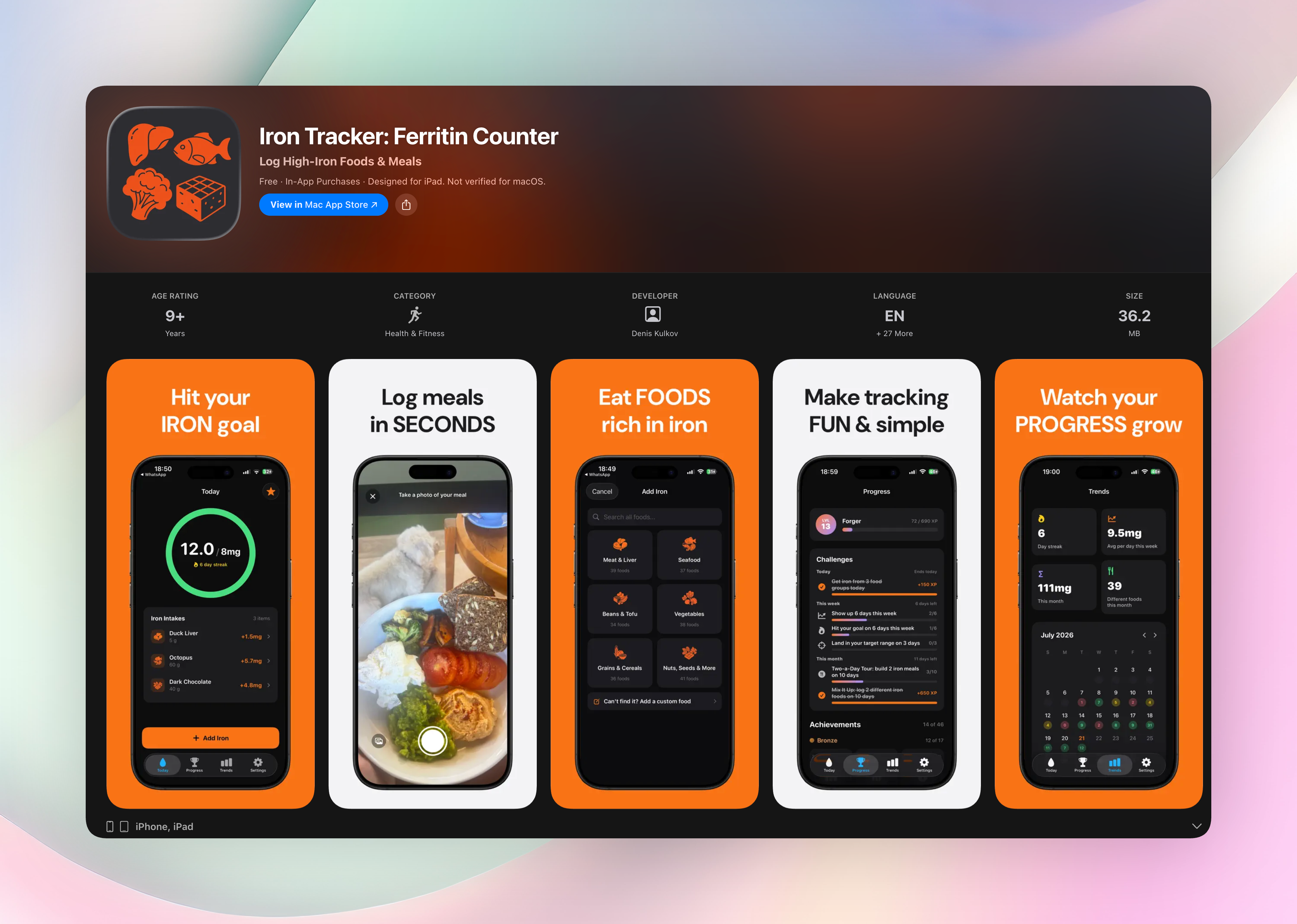
Food tables describe what goes in your mouth. Two days can both total 18 mg and differ several-fold in what crosses the gut wall, depending on how much came from meat, whether vitamin C was present, and how much sat behind oxalate or tannins. If you keep a running record — on paper or in an app like Iron Tracker, an iron intake tracking app for iPhone — noting each entry's form next to its milligrams keeps the daily number honest.
That generalizes past spinach. Every iron figure on a label or in a database is a ceiling, not a delivery estimate.
FAQ
Does spinach have iron, or is that a myth?
It has iron — the myth is the amount and how much you absorb. A cooked cup carries about 6 mg on paper; the absorbed fraction disappoints because the iron is non-heme and the leaf is loaded with oxalate.
How much iron in spinach per cup?
About 0.8 mg per cup raw and about 6 mg per cup cooked. The gap is volume, not chemistry: a cup of cooked spinach is roughly six times as much leaf as a cup of raw.
Does cooking spinach increase its iron?
Not per gram in any meaningful way. Per cup, yes, because the leaves shrink so dramatically. Boiling and draining has a separate benefit: it pulls soluble oxalate into the water you throw away.
Is spinach a good iron source for vegetarians?
It's a supporting player, not a foundation. Lentils, beans, tofu, and fortified grains carry more iron per serving with far less oxalate, and pairing any of them with a vitamin C source does more for the day's absorbed total than adding spinach.
Free Iron tools
- Daily Iron RDA CalculatorEnter your age, sex, life stage and diet to see the published iron RDA, upper limit and vegetarian or vegan adjustment.
- Ferritin Change CalculatorCompare two ferritin test results with their dates and units to calculate the absolute change, percentage change and rate over time.
- Ferritin Unit ConverterEnter the ferritin value from your blood test and the unit your laboratory printed. The converter shows the same number in ng/mL, µg/L and pmol/L at once, with the standard adult reference ranges alongside it for comparison.
- Heme vs Non-Heme Iron ComparisonCompare heme vs non heme iron by entering the two amounts. See total iron and a clear percentage split for each form.
- Hemoglobin Unit ConverterHemoglobin lab test units are not the same everywhere. Enter the number on your report, pick the unit it is printed in, and convert hemoglobin g/dL to mmol/L or g/L — with the same value shown in all three units and the standard adult reference ranges beside it.
- Iron and Ferritin Level ChartPlot an iron or ferritin result against commonly used reference ranges. Choose the test, enter its value, and see whether it falls in the low, typical or high band.
- Iron-Rich Foods ChartCompare iron-rich foods by category, serving size and diet preference. See iron per serving, heme or non-heme type, and percent Daily Value.
- Iron-Rich Foods for Anemia ChartFilter a static food table by diet, serving size and iron type to compare iron per serving with preparation notes. This is a food reference, not a diagnosis.
- Iron Supplement Supply CalculatorEstimate how long a bottle lasts, its daily and 30-day cost, elemental iron per day and the date it runs out.
- MCH CalculatorEnter the hemoglobin value and red blood cell count from your blood test report. Get mean corpuscular hemoglobin (MCH) in picograms, plus where that number sits against the standard adult reference range of 27–33 pg. Nothing here is a diagnosis — lab results are interpreted by a clinician.
- Transferrin Saturation CalculatorEnter the serum iron and TIBC printed on your blood test and pick the unit they were reported in. Get transferrin saturation as a percentage, both values echoed in the other unit, and where the percentage falls against the published adult reference range.
- Vegetarian Iron Foods ChartCompare vegetarian iron sources by serving size, rank them by iron per portion, and see their contribution to your selected daily target.